



The iPhone 18 Pro Max could feature under-display Face ID for a true all-screen design, a 48MP main camera with variable aperture, and Apple’s first 2nm A20 Pro chip built by TSMC. Based on investor notes from Ming-Chi Kuo and reporting from Bloomberg’s Mark Gurman in Q2 2026, it is expected to launch in September 2026.
If you are using an iPhone 15 Pro Max or 16 Pro Max and debating whether to skip the next upgrade, this is the cycle to watch. The iPhone 18 Pro Max is not shaping up as a small refinement. It looks like the model where Apple finally ships the technologies it pulled from the last two generations.
The reason the rumor stack is so large is simple. Under-display Face ID, solid-state buttons, and the 2nm chip were all targeted for earlier phones. Yield issues at TSMC and reliability problems with haptic buttons pushed them. Now they are converging on a single device. That is what makes the 18 Pro Max different.
Below is a consolidated tracker of the eight rumors that have actual supply chain weight behind them, how likely each one is, and what it would actually change for you.
At a Glance: All iPhone 18 Pro Max Rumored Features
The iPhone 18 Pro Max could feature a true all-screen front with under-display Face ID, a brighter micro-lens OLED display with thinner bezels, an A20 Pro chip built on TSMC’s 2nm process with 12GB RAM, a 48MP main camera with variable aperture, a larger 48MP periscope telephoto sensor, long-delayed solid-state haptic buttons, and iOS 20 exclusives powered by a new C2 modem and Wi-Fi 7. Here is how credible each one is.
1. A True All-Screen Design With Under-Display Face ID
The iPhone 18 Pro Max is likely to feature under-display Face ID. Confidence: High.
This is the most reported change for 2026. Ross Young of Display Supply Chain Consultants, who has called Apple’s display roadmap correctly for four consecutive generations, has said Apple is targeting under-panel Face ID for 2026. Bloomberg’s Mark Gurman reported in May 2026 that Apple has prototype panels where the infrared components for Face ID sit beneath the OLED and work through the display.
If it ships, the Dynamic Island shrinks. It does not go away. The large pill that currently holds the Face ID sensors disappears. What remains is a single small punch-hole for the front camera. That would give the Pro Max the cleanest front of any iPhone to date.
A common mistake is to assume the front camera also goes under the display. It almost certainly will not in 2026. Under-display selfie cameras still compromise sharpness and low-light performance, and Apple will not accept that trade on its flagship.
2. Thinner Bezels and New LTPO Display Technology
The display could get significantly brighter and more efficient. Confidence: Medium-High.
Separate from Face ID, Apple is testing micro-lens array OLED from Samsung Display and LG Display. In plain terms, MLA adds a layer of microscopic lenses that push light that would normally be trapped inside the panel out toward your eyes. Supply chain reports suggest a 30 percent increase in peak brightness without more power. You would feel it outdoors and when watching Dolby Vision video.
The panel is also expected to use an upgraded LTPO backplane that can drop the always-on display below 1Hz, saving battery overnight, and Border Reduction Structure tech to shrink the bezels further, similar to what Apple did on Apple Watch Series 10. It sounds minor, but thinner bezels make the phone feel more immersive without making it larger.
3. Next-Gen A20 Pro Chip on TSMC’s 2nm Process
The iPhone 18 Pro Max will almost certainly run the A20 Pro. Confidence: High.
This is Apple’s first chip built on TSMC’s N2 node. TSMC, Apple’s sole high-end chip manufacturer, is producing this node in Taiwan, and 2nm is a bigger leap than the marketing suggests. The gain is not just speed. Early fab data points to about 15 percent higher performance and roughly 30 percent better efficiency for the same workload.
For real use, that means two things. First, sustained performance. Games, 4K exports, and Apple Intelligence tasks that currently cause the phone to get warm and throttle should run longer before heating up. Second, battery life. Apple can either keep the same chassis and give you noticeably more screen-on time, or shave a little thickness while holding battery steady.
It is expected to be paired with 12GB of RAM. That jump is not for multitasking. It is for on-device Apple Intelligence. The larger language models Apple wants to run entirely on device in iOS 20 need that memory resident.
When benchmarks leak, ignore the headline CPU number. Watch the Neural Engine. That is where iOS 20 will live or die.
4. Variable Aperture 48MP Main Camera System
The main camera could finally get a physical variable aperture. Confidence: High.
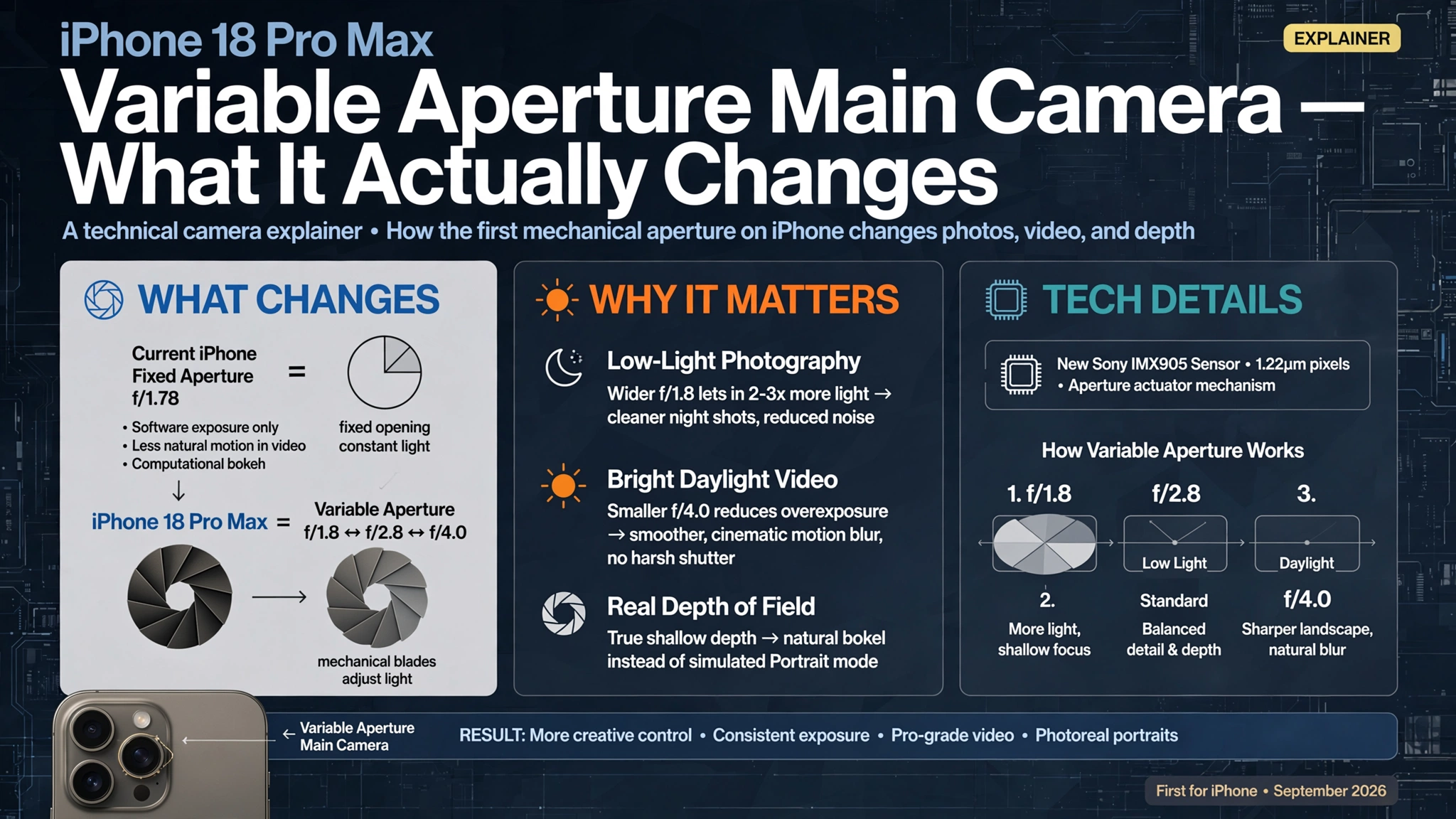
Ming-Chi Kuo said in an investor note on April 18, 2026, that Apple has ordered variable aperture components for the 2026 Pro iPhones. Right now your iPhone shoots at a fixed aperture, around f/1.78, and fakes blur. A variable aperture physically opens and closes like a DSLR lens.
Wide open at f/1.4, it gathers far more light for indoor shots of kids or pets and gives you natural background blur without the glitchy edges software blur sometimes leaves. Stopped down to f/2.8 in bright sun, the whole frame gets sharper, not just the center. Landscapes and group photos benefit most.
This is not a megapixel upgrade. It is an image quality upgrade that makes 24MP and 48MP shots look more optical and less computational.
5. Major Upgrade to Periscope Telephoto and Ultra-Wide Lenses
The periscope telephoto is due for its first major sensor upgrade. Confidence: Medium.
The 17 Pro Max is expected to keep the 12MP tetraprism hardware. For the 18 Pro Max, leaks point to a larger 1/2.5-inch 48MP sensor for the 5x telephoto. A larger sensor helps most at dusk, where current 5x shots get noisy. It also makes 10x and 25x digital zoom actually usable, rather than watercolor-like.
The ultra-wide will likely remain 48MP but with new lens coatings to tame flare, a persistent complaint from Pro users shooting night video.
The front camera will probably move to 24MP. Prototypes with an under-display front camera exist, but display supply chain sources say image quality is not yet at Apple’s standard. Expect an improved conventional sensor instead.
6. Solid-State Haptic Buttons After Years of Delays
Apple is still working on solid-state buttons. Confidence: Medium.
Internally called Bongo, this project was meant for the iPhone 15 Pro and was pulled late due to reliability and yield issues. Jeff Pu reported in March 2026 that Apple restarted development with a new supplier approach.
These buttons don’t move. A Taptic Engine simulates the click, like the iPhone 7 home button or a MacBook trackpad. No moving parts means better water resistance and fewer failures. It also allows pressure sensitivity. A light press could lock focus, a hard press takes the shot, which you cannot do cleanly with a mechanical button.
A simple way to spot fake leaks: if early CAD renders show two separate volume buttons, that unit is still mechanical. The solid-state design merges them into one long strip.
7. Exclusive iOS 20 and Apple Intelligence Features
The iPhone 18 Pro Max will run iOS 20, but some of iOS 20 will only run well on it. Confidence: Medium-High for exclusivity, High for hardware.
Since iOS 18, Apple has tied advanced Apple Intelligence to newer chips. With 12GB RAM and a next-generation Neural Engine in the A20 Pro, the 18 Pro Max is positioned to run larger, multimodal models that understand what is on your screen and take action across apps entirely on device.
On the hardware side, this is also the model expected to debut Apple’s C2 modem, further reducing reliance on Qualcomm, and Wi-Fi 7 with simultaneous multi-band transmission. That helps most in crowded networks like airports and apartment buildings.
What iPhone 18 Pro Max Will NOT Feature
Three rumors are repeatedly shared but have almost no credible supply chain evidence for 2026.
A completely portless iPhone with no USB-C. Apple has tested it, but EU regulations and the needs of Pro users moving large ProRes files make it impractical for a Pro Max this year.
The return of Touch ID under the display or in the power button. All signals from the display and assembly chain show Apple is fully committed to Face ID for the flagship.
A 200MP camera sensor. Apple has never chased megapixel counts. Its strategy is larger pixels, larger sensors, and better processing, not a marketing number.
iPhone 18 Pro Max Release Date and Expected Price
Apple is expected to launch the iPhone 18 Pro Max in mid-September 2026, following its usual schedule. Price is where the 2nm chip matters. TSMC’s 2nm wafers are significantly more expensive than 3nm. Analysts including Jeff Pu expect Apple to absorb some of that cost but still raise the starting price by $50 to $100 in the US, to around $1,249 to $1,299 for the base model. If you are budgeting, plan for that increase.
Should You Wait for the iPhone 18 Pro Max?
It depends on what is in your pocket now and what frustrates you.
If you have an iPhone 15 Pro Max or 16 Pro Max that still holds a full day and you care most about display design, waiting is rational. The iPhone 17 Pro Max is expected to be a refinement year, while the 18 Pro Max is the redesign year.
If you have an iPhone 13 Pro Max, 14 Pro, or older and your battery is weak or you are missing shots because of low-light camera performance, do not wait twelve months for a rumor. The 17 Pro Max will still be a major upgrade, and trade-in values will stay strong if you decide to jump again.
The trap is waiting forever for the perfect year. If under-display Face ID slips again, perfect becomes 2027. Start with how your current phone is treating you today.
Frequently Asked Questions About iPhone 18 Pro Max Features
What is the biggest rumored feature of iPhone 18 Pro Max?
Under-display Face ID that shrinks the Dynamic Island to a small hole-punch. It is the most widely reported change and would create the first true all-screen iPhone.
Will iPhone 18 Pro Max finally remove the Dynamic Island?
Not completely. Face ID components are expected to move under the display, but the front camera will remain as a small punch-hole cutout.
Will iPhone 18 Pro Max price be higher?
Most likely yes. Because the A20 Pro uses TSMC’s more expensive 2nm process, a $50 to $100 increase in the US is expected, to around $1,249 to $1,299.
