


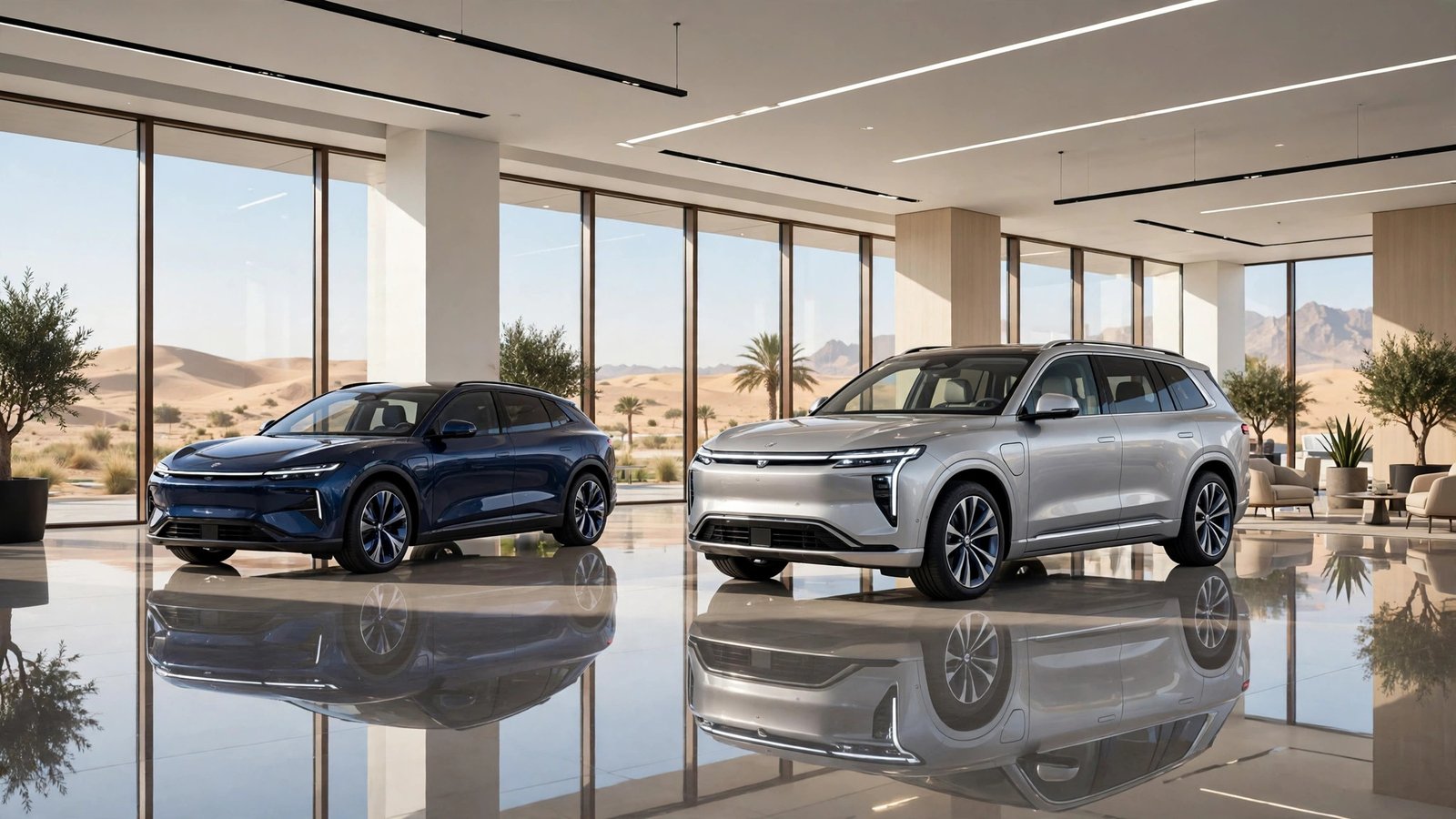
Xiaomi has started selling its electric cars outside China for the first time. UAE dealer Gargash Prime Automotive has opened presales for the Xiaomi SU7 electric sedan, the YU7 electric SUV and the SkyNomad extended-range SUV, with the first customer deliveries scheduled for December 2026. For a company that only started delivering cars in 2024, this is the biggest step yet in its plan to become a global car brand — and the UAE is the test market before a much bigger push into Europe in 2027.
Until now, anyone outside China who wanted a Xiaomi car had to rely on parallel importers, with no official warranty, no local service network and no guarantee the car was built for their market. The UAE listings change that: buyers get an authorised local sales channel, a warranty of up to five years or 150,000 km, scheduled maintenance coverage up to 60,000 km, and leasing plans. It is a small first step — 13 variants through a single dealer group — but it is the first time Xiaomi’s cars have been sold through an official channel anywhere outside China.
Which Xiaomi cars can you buy in the UAE, and what do they cost?
Gargash Prime lists 13 variants across the three models. Prices start at AED 169,900 (about $46,263) for the SU7 Standard, AED 184,900 (about $50,347) for the YU7 Standard and AED 209,900 (about $57,155) for the SkyNomad. The most expensive listing is the SU7 Ultra performance sedan at AED 375,900 (about $102,355).
| Model | UAE starting price | China starting price |
|---|---|---|
| Xiaomi SU7 | AED 169,900 ($46,263) | 219,900 yuan ($33,011) |
| Xiaomi YU7 | AED 184,900 ($50,347) | 233,500 yuan ($35,052) |
| Xiaomi SkyNomad | AED 209,900 ($57,155) | 209,900 yuan ($31,509) |
The gap between UAE and Chinese prices is the first thing buyers will notice. After currency conversion, the SU7 costs about 40% more in the UAE than in China, the YU7 about 44% more, and the SkyNomad roughly 81% more. That premium covers import costs, taxes and local distribution, and it is the price of buying through an official channel instead of a grey-market importer. Whether UAE buyers accept it will be an early test of how much the Xiaomi badge is worth outside China.
Leasing is also available. Monthly payments start at AED 3,899 (about $1,062) for the SU7 Standard, AED 4,199 (about $1,143) for the YU7 Standard and AED 4,699 (about $1,280) for the SkyNomad N70 Pro. Buyers can order online or visit the display area at Etihad Mall in Dubai.
When will the cars actually arrive?
Not every variant arrives at the same time. Five versions are listed for delivery in December 2026: the SU7 Standard and SU7 Ultra, the YU7 Standard, and the SkyNomad N70 Pro and both N90 versions. The other eight variants are listed for February 2027 delivery.
All three models are built to order, and initial allocations are limited, according to reports on the launch. That means early buyers may face a wait even after the December window opens, and delivery timelines could stretch into early 2027 for the later variants. If you are considering one, the December batch is the one to watch — it is the first real test of whether Gargash Prime can deliver Xiaomi cars on schedule outside China.
The cars themselves: sedan, SUV and a 1,700 km range-extender
The SU7 and YU7 are pure battery-electric models. The SU7 is the sedan that made Xiaomi famous in cars: a sleek four-door that competes with the Tesla Model 3 and Porsche Taycan on looks and, in its top form, on performance. Its highest-performance version, the SU7 Ultra, produces 1,138 kW — about 1,526 horsepower. The YU7 is the family SUV version of the same formula, and its top YU7 GT version produces 738 kW, about 990 horsepower.
The SkyNomad is a different kind of vehicle. It is an extended-range electric SUV: a 1.5-litre turbocharged petrol engine works as a generator, charging the battery rather than driving the wheels. It comes in five-seat N70 and seven-seat N90 versions. The N70 Pro uses a 52 kWh lithium iron phosphate (LFP) battery, while higher versions use a 76 kWh nickel manganese cobalt (NMC) pack. The N90 is listed with a combined CLTC range of 1,705 km (about 1,060 miles) — roughly 1,321 to 1,328 km under the stricter WLTP standard, made up of 363 to 370 km of pure-electric WLTP range plus a 60-litre fuel tank.
The entry-level SU7 and YU7 share a 73 kWh LFP battery and an 800-volt platform, which is the hardware that enables fast DC charging. Reported figures for the SU7 Standard put it at 320 hp, 0–100 km/h in 5.28 seconds and 720 km of CLTC range, while the SU7 Ultra is reported to reach 100 km/h in 1.98 seconds with 620 km of CLTC range. The YU7 Standard is reported at 320 hp, 0–100 km/h in 5.90 seconds and 643 km of CLTC range. Treat these as reported figures from early coverage rather than official UAE specifications — Gargash Prime’s own listings are the final word on what each variant delivers.
Why the UAE, and why now?
Xiaomi’s timing is deliberate. At the 2026 APEC CEO Summit in Shenzhen on November 17, Xiaomi CEO Lei Jun said the company would officially enter overseas markets next year. The UAE presales, which opened two days later, are the first concrete step toward that 2027 expansion — a low-risk way to learn how to sell, service and support cars abroad before the bigger European launch.
The groundwork for Europe is already being laid. In September 2026, Xiaomi signed memorandums of understanding with eight German dealer groups, including Emil Frey and LUEG, ahead of its planned European entry. The company has also advertised automotive legal and finance roles in Sydney, Australia, which suggests it is preparing for possible right-hand-drive operations — though that hiring does not confirm an Australian launch.
The UAE also makes sense as a first market for a practical reason: it is a wealthy, car-loving market where premium EVs already sell, and a single distributor can cover the whole country. Gargash Prime is the premium automotive division of the Gargash Group, a company founded in 1918 that has previously represented brands such as Mercedes-Benz, Alfa Romeo and GAC. For Xiaomi, that is a credible local partner with showrooms, service centres and a customer base that already buys premium cars.
How big is Xiaomi in cars already?
Bigger than most people outside China realise. Xiaomi Auto posted wholesale deliveries of 50,168 vehicles in October 2026, alongside domestic retail sales of 50,123 units. That is roughly 50,000 cars a month from a brand that delivered its first car in April 2024. For comparison, that monthly volume is already in the same league as established EV makers’ China sales.
There is also a small clue that the UAE launch was already in motion: data from an automotive industry platform shows Xiaomi exported exactly 45 vehicles in October 2026. Since the company had not yet begun large-scale overseas deliveries, those shipments may have been linked to the first batch of vehicles sent to the UAE — though that connection is reported, not confirmed by Xiaomi.
The company’s previously disclosed plans put full global commercialisation in the second half of 2027, with Europe first, followed by right-hand-drive markets in the first half of 2028. The UAE presales arrive earlier than that timetable, which suggests Xiaomi is moving faster than its own schedule — or that the UAE is a pilot run ahead of the main event.
Should you buy one?
If you live in the UAE and have been waiting for an official way to buy a Xiaomi car, this is it — with a warranty, local servicing and leasing, which no parallel import could offer. The December delivery batch (SU7 Standard and Ultra, YU7 Standard, SkyNomad N70 Pro and both N90 versions) is the one to target if you want a car soon.
But go in with your eyes open. The UAE prices carry a steep premium over China — 40% or more on the SU7 and YU7, and far more on the SkyNomad. Allocations are limited and the cars are built to order, so delivery dates may slip. And the resale market for Xiaomi cars outside China does not exist yet, so nobody can tell you what your SU7 will be worth in three years. The smart move is to compare the UAE price against a parallel import with no warranty, and decide whether the official warranty and service network are worth the premium. For many buyers, they will be. For bargain hunters, the China price will always look better — but that price was never really available to you anyway.
What happens next
Watch three things. First, whether the December deliveries actually happen on time — that will tell you how serious Xiaomi’s overseas operation is. Second, whether Gargash Prime expands the range or adds more variants in early 2027, when the remaining eight variants are due. And third, the European launch: with German dealer agreements already signed, the next announcement could come at any time, and Europe is where Xiaomi’s global car ambitions will really be judged. The UAE is the rehearsal. Europe is the show.
Frequently Asked Questions
Q: When did Xiaomi start selling cars in the UAE?
A: Presales opened on November 19, 2026, through UAE dealer Gargash Prime Automotive. It is the first time Xiaomi cars have been sold through an official channel outside China.
Q: How much does the Xiaomi SU7 cost in the UAE?
A: The SU7 starts at AED 169,900 (about $46,263) for the Standard version. The most expensive version, the SU7 Ultra, is listed at AED 375,900 (about $102,355).
Q: When will Xiaomi cars be delivered in the UAE?
A: The first deliveries are scheduled for December 2026 for the SU7 Standard and Ultra, the YU7 Standard, and the SkyNomad N70 Pro and both N90 versions. The remaining eight variants are listed for February 2027.
Q: What is the Xiaomi SkyNomad?
A: The SkyNomad is an extended-range electric SUV. A 1.5-litre turbocharged petrol engine works as a generator to charge the battery. It comes in five-seat N70 and seven-seat N90 versions, with the N90 listed at up to 1,705 km of combined CLTC range.
Q: Will Xiaomi sell its cars in Europe?
A: Yes — Xiaomi plans a wider international expansion in 2027, with Europe first. In September 2026 it signed agreements with eight German dealer groups, including Emil Frey and LUEG, ahead of that launch. Full global sales are expected from the second half of 2027.
Sources: CarNewsChina (November 19, 2026); TechNode (November 19, 2026); ChinaEVHome (November 18, 2026); The Electric Viking (November 19, 2026).
