


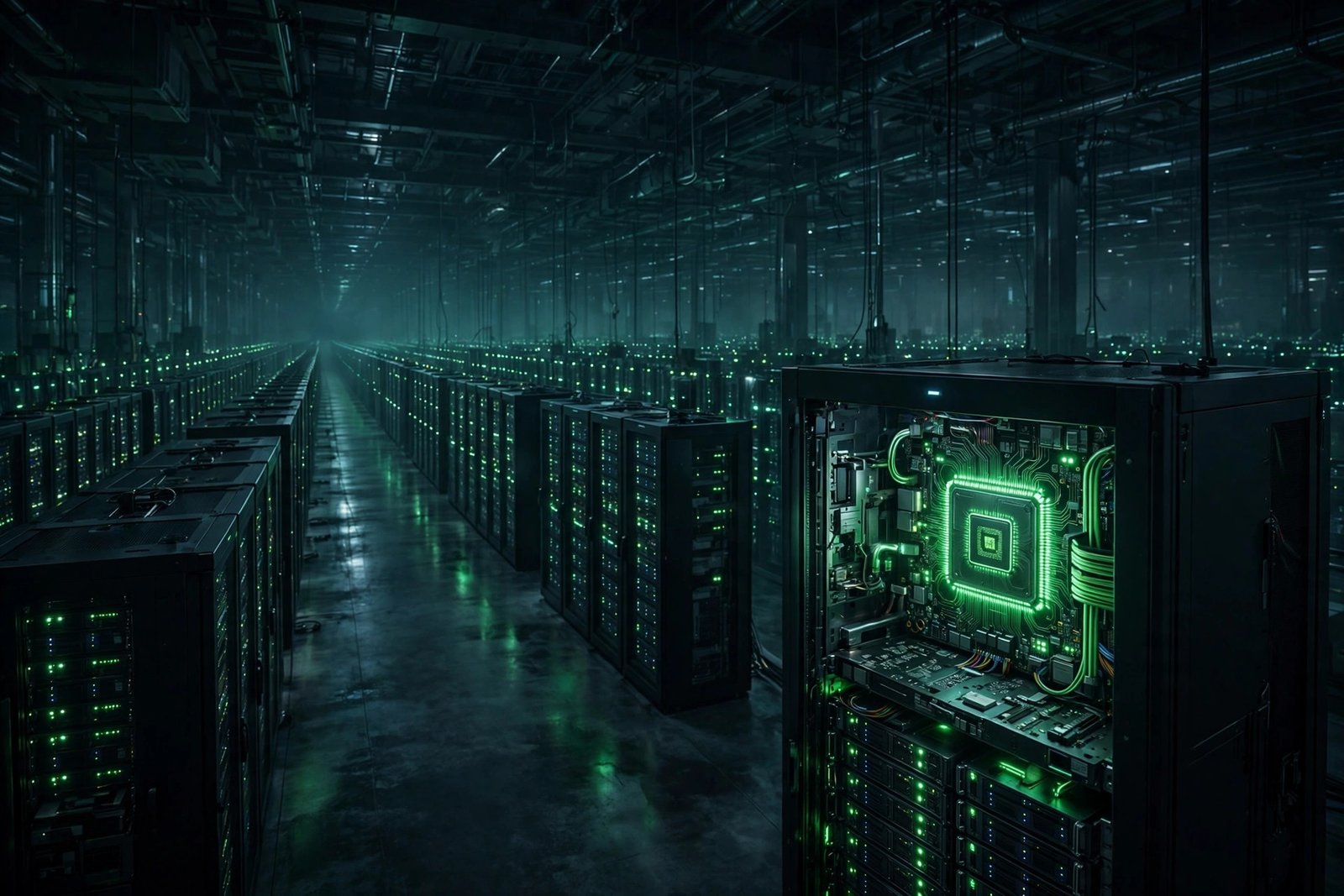
Nvidia’s most powerful artificial intelligence chips have been found installed at a data center in China, in what appears to be the first documented case of the company’s export-controlled Blackwell hardware reaching the country.
Bloomberg reported on November 27, 2026, that loan documents filed with Chinese regulators list a GB300 NVL72 rack and a GB200 server — both built on Nvidia’s Blackwell chips — at the Yangtze River Delta Project, a huge data center development in Shanghai. The filings tie the site to Alice Huang, the businesswoman at the center of a United States investigation into whether Nvidia chips were smuggled into China in defiance of American export controls.
Blackwell chips cannot legally be shipped to China without a US export license. The discovery is therefore a significant moment in the years-long contest over who gets access to the world’s most advanced AI hardware — and it directly challenges Nvidia chief executive Jensen Huang’s repeated argument that the giant server racks are simply too big and heavy to smuggle.
What Bloomberg found
The evidence comes not from a leak or a whistleblower, but from routine financial paperwork. Two Chinese companies offered Nvidia hardware as collateral for bank loans, and in doing so they put the equipment’s serial numbers and model names into documents submitted to Chinese regulators.
The first company, Shanghai Shuoyao, offered a GB300 NVL72 rack as collateral for a 96 million yuan loan — about 14 million dollars — from Shanghai Innovation Bank. The documents, filed in November, included the rack’s serial number. Bloomberg entered that number into a public warranty database and found the rack was manufactured by Gigabyte Technology, the Taiwanese company that assembles Nvidia chips into servers. The model name matched a GB300 NVL72 server rack built by Gigabyte.
The second company, Shanghai Kezhan, described a GB200 server in paperwork for a 90 million yuan loan it obtained in late 2025 from a finance-leasing firm. That lender is wholly owned by a Shanghai government agency. Kezhan also disclosed 32 servers carrying H200 chips at the same site, though those documents gave no serial numbers, making them harder to trace.
The filings do not stop at Blackwell. Shanghai Longjie, a company that shares a parent with Shuoyao, reported servers carrying Hopper-generation chips from Super Micro Computer and Dell Technologies, and used them to secure a 200 million yuan loan from Shanghai Innovation Bank. It is unclear whether those shipments had US approval.
The Yangtze River Delta Project itself is enormous. Local media have described it as a facility designed to hold as many as 800,000 servers, which would put it on par with the largest hyperscale data centers in the world. Construction plans for the project set targets for total processing power against energy input — targets that would be extremely difficult to meet using chips from Chinese companies such as Huawei.
The site and the woman at the center of it
The Shanghai data center has been linked to Megaspeed, a Singapore-based cloud company, since at least 2024. That year Megaspeed used a rendering of the Yangtze River Delta Project to describe its largest data center to investors, calling it a “specific area” facility in an unnamed country.
Alice Huang founded Megaspeed in 2023. Nvidia gave the young company a coveted stamp of approval within four days of its creation, and Megaspeed went on to become Nvidia’s largest customer in Southeast Asia. Reports have also noted a personal relationship between Alice Huang and Nvidia chief Jensen Huang, which has made the controversy around the company even more closely watched.
The US government is now investigating whether Megaspeed smuggled Nvidia chips into China. The Commerce Department and the Justice Department confirmed a probe into the company on November 17, and on November 23 the Trump administration added Megaspeed and six related firms in Singapore, Malaysia and Thailand to the US trade blacklist, citing a significant risk of involvement in chip diversion. A new rule also added license requirements for several Southeast Asian countries.
There is, however, no evidence so far that Megaspeed itself diverted the hardware found in Shanghai. Megaspeed has denied wrongdoing and has not answered questions about the Yangtze River Delta Project. Shanghai Shuoyao, which has significant overlap with Megaspeed and is active at the site, made a rare public statement this month confirming that it is one of Megaspeed’s service providers, while describing the relationship as “limited to ordinary commercial cooperation.” The company had not responded to repeated requests for comment over the previous year.
The ownership links run deep. Kezhan is headquartered about half a kilometer from the project. A subsidiary of the Chinese gaming company 7Road — Megaspeed’s original parent — holds 16.7 percent of Kezhan. The rest is ultimately owned by NeXPower Japan, a Tokyo firm that the Chinese financial publication Caixin reported is controlled by Alice Huang.
How did the chips get to China?
That is the question nobody can yet answer — and it is the question that matters most to Washington.
Gigabyte, which manufactured the GB300 rack, was given the serial number and asked whom it originally sold the rack to and when. The company declined to say, citing company policy. A spokesperson said only that Gigabyte “conducts all business in compliance with applicable laws and regulations.” Nvidia did not respond to Bloomberg’s questions about the report.
Hardware like this often passes through several hands, including local distributors, before it reaches a data center. Many smuggled products were first sold to buyers in places without export restrictions, which makes the trail difficult to follow.
Customs data points to one possible route. In May 2025, Kezhan received an 11 million dollar shipment flown from Malaysia to Shanghai Pudong International Airport. The paperwork described the goods as a “storage chassis,” but the shipment carried product code 847150, which covers computing servers, and its unit price of 264,108 dollars was far too high for a storage chassis. That price fits servers built on Hopper chips.
It is also worth noting what the filings do not show. The collateral records cover only equipment pledged for loans, so they show a small part of what a site of that size would need. It is unclear how far along the operators are toward the 800,000-server goal, or what mix of servers they plan to use. The filings also show that Chinese lenders, including some with government ties, accepted restricted hardware as collateral — a detail that may draw scrutiny of its own.
Why this matters
The discovery lands at a sensitive moment for the global AI race. The Trump administration has said it does not want China to have Nvidia’s more advanced AI chips, and in recent weeks it has tried to shore up export controls to make it harder for Chinese tech firms to remotely access American-made chips from companies based in Southeast Asia and Brazil.
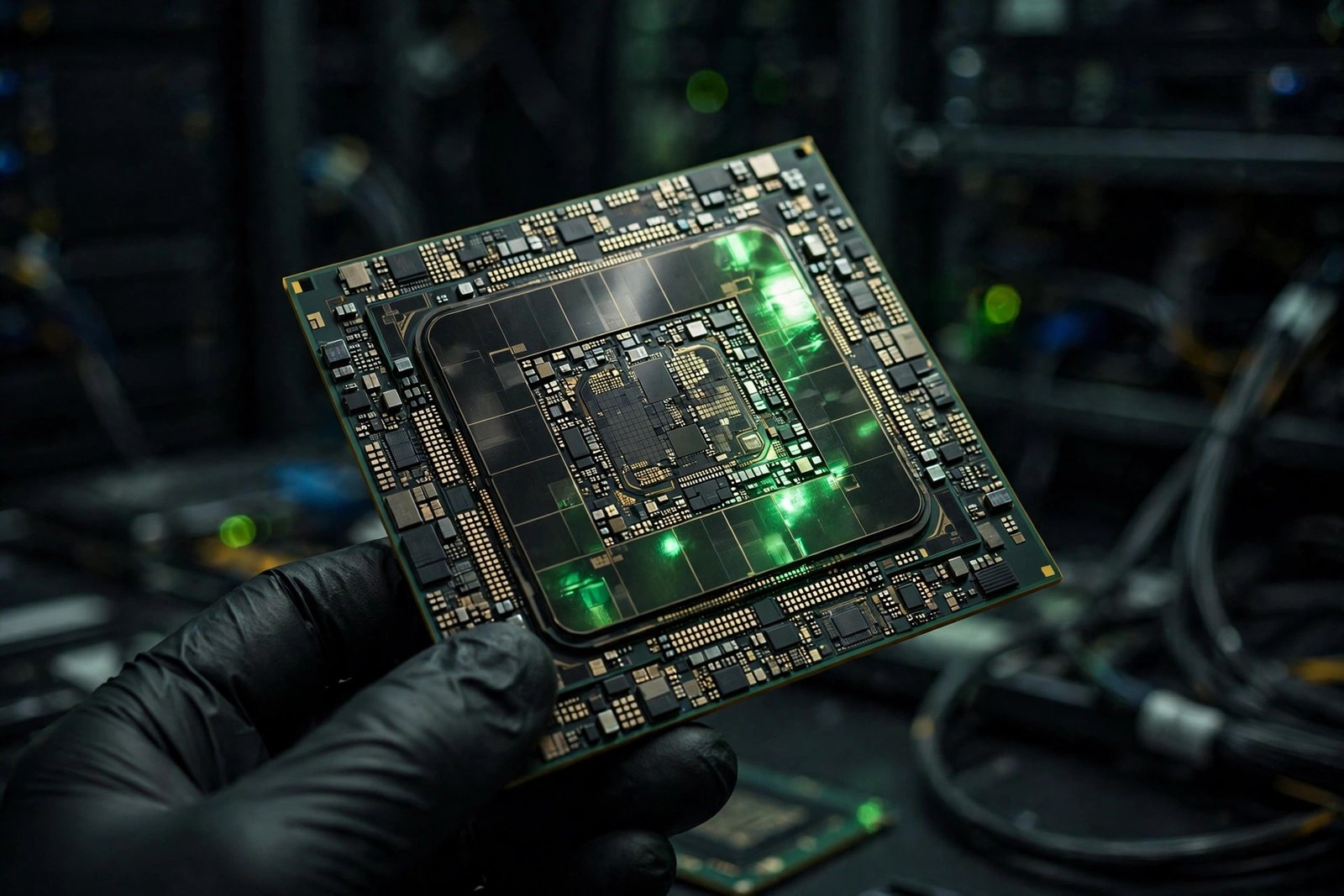
Blackwell is Nvidia’s most advanced AI silicon, used by OpenAI and Anthropic to train their most capable models. The GB300 NVL72 alone contains 72 Blackwell Ultra chips and 36 Grace processors in a single rack. Keeping that hardware out of China has been a central aim of US policy, on the argument that advanced AI computing power has direct military and strategic value.
That is also why Jensen Huang’s own words are now being quoted back at him. The Nvidia chief said in 2025 that he saw no evidence of AI chip diversion into China, and has argued that the systems are too big to smuggle — the GB300 NVL72 stands about two meters tall and weighs roughly 1,500 kilograms. The Shanghai filings do not prove how the rack arrived, but they do prove that it arrived, which is the part that undercuts the argument.
The episode also comes as Nvidia itself has been in the headlines for other reasons. Jensen Huang was recently reinstated as Nvidia’s chief executive after a boardroom battle, a reminder of how much of the company’s story now revolves around its leader. The Blackwell discovery adds a geopolitical headache to a company that is already navigating boardroom politics, investor scrutiny and a US-China technology standoff at the same time.
For the wider industry, the finding raises uncomfortable questions. If the most restricted AI hardware in the world can end up installed at a Shanghai data center, how effective are the export controls really? And how much more hardware is out there that has never been pledged as loan collateral and therefore never appeared in any public filing? The documents Bloomberg reviewed may be only the visible tip of a much larger flow.
What happens next
Several threads are now running in parallel. The US investigation into Megaspeed continues, and the blacklist designation gives American officials new tools to pursue the companies involved. Gigabyte faces questions about where its racks were first sold, and Nvidia faces questions about how its most tightly controlled product ended up in a Chinese data center.
More filings may surface. The Yangtze River Delta Project is a vast site, and the loan documents reviewed so far cover only a fraction of the equipment it would need. If other companies at the site have pledged hardware for loans, further Blackwell or Hopper systems could come to light in the same way.
For now, the direct financial impact on Nvidia looks limited. The company’s guidance already assumes no data center sales in China, so the discovery does not change its expected revenue. The damage is instead to confidence — confidence in the export control regime, in the supply chain, and in the claim that the world’s most powerful AI chips cannot be moved where they are not supposed to go.
That confidence will be tested again as the investigation unfolds. Until the route the chips took is established, every new filing out of Shanghai will be read as a clue — and every claim that the hardware is too big to smuggle will be measured against a rack that is already sitting in a Shanghai data center.
Related reading
- Character.AI bankruptcy: 42 states move to block the chat sale — https://techinkey.com/character-ai-bankruptcy-42-states-block-chat-sale/
- US Air Force Cloud One hack and breach — https://techinkey.com/us-air-force-cloud-one-hack-breach/
Frequently asked questions
Q1: What did Bloomberg find about Nvidia Blackwell chips in China?
A1: Bloomberg reported on November 27, 2026, that Nvidia’s Blackwell AI hardware has been found installed at a Shanghai data center. Loan documents filed with Chinese regulators list a GB300 NVL72 rack and a GB200 server at the Yangtze River Delta Project, and the filings are the first public evidence that Blackwell processors reached China.
Q2: Can Nvidia Blackwell chips legally be sold to China?
A2: No. Nvidia’s Blackwell chips cannot be shipped to China without a US export license. The Trump administration has opposed sending Blackwell chips to China, and Megaspeed and six related firms were added to the US trade blacklist in November 2026 over the risk of chip diversion.
Q3: What is the Yangtze River Delta Project data center?
A3: The Yangtze River Delta Project is a large data center development in Shanghai, described in local media as a facility designed to hold as many as 800,000 servers. Megaspeed used a rendering of the project in 2024 to describe its largest data center to investors, and the site is linked to Alice Huang, the founder of Megaspeed.
Q4: Who is Alice Huang and what is Megaspeed?
A4: Alice Huang founded Megaspeed, a Singapore-based cloud company, in 2023. Nvidia approved the company within four days of its creation, and it became Nvidia’s largest customer in Southeast Asia. The US government is investigating whether Megaspeed smuggled Nvidia chips into China, and Megaspeed has denied wrongdoing.
Q5: How were the Nvidia Blackwell chips traced to China?
A5: Shanghai Shuoyao offered a GB300 NVL72 rack as collateral for a 96 million yuan loan from Shanghai Innovation Bank and included the rack’s serial number in documents filed with Chinese regulators in November. Bloomberg entered the serial number into a public warranty database and found the rack was made by Gigabyte Technology. A second firm, Shanghai Kezhan, described a GB200 server in loan paperwork from late 2025.
Q6: What happens next in the Nvidia Blackwell China investigation?
A6: The US investigation into Megaspeed continues, and American officials may take further action against the companies involved. More loan filings could reveal additional Blackwell or Hopper hardware at the Shanghai site, and Gigabyte and Nvidia face questions about where the racks were first sold. Nvidia’s guidance already assumes no data center sales in China, so the direct financial impact is limited.
