


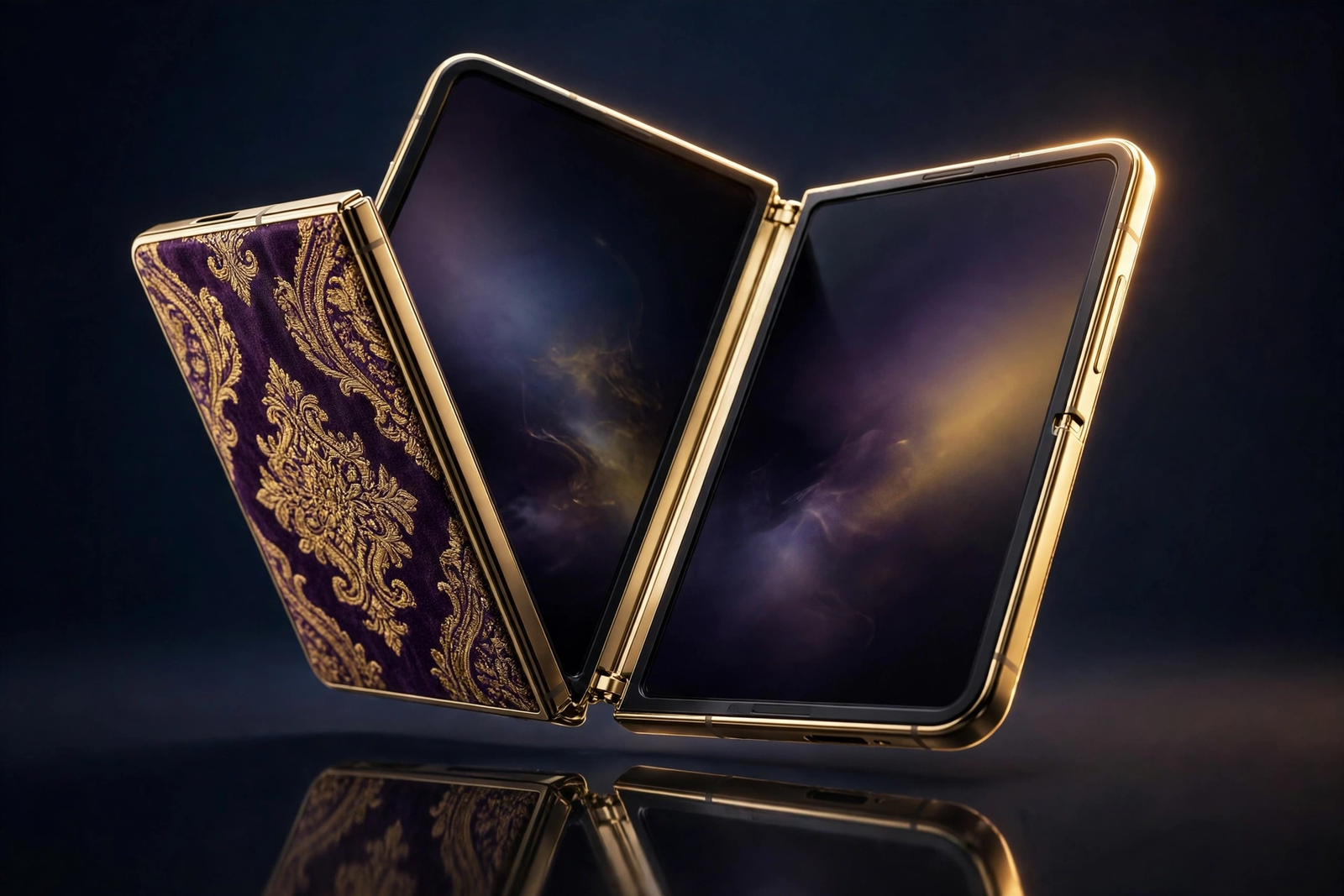
Huawei Mate X8 Launched in China With a Magnetic Hinge That Flattens the Crease
Huawei has officially launched the Mate X8 in China, and the headline is not the screen size or the chip. It is the crease. The new book-style foldable uses a magnetic system under its inner display that Huawei says pulls the screen almost flat when the phone opens, cutting the crease height from 142 microns on the Mate X7 to as little as 15 microns. The phone was unveiled on November 24, 2026, at Huawei’s Mate X8 and all-scenario event in China, with pre-orders opening the same evening and open sales starting on December 4.
The Mate X8 is a conventional book-style foldable, not a wide fold like Huawei’s own Pura X Max. It opens to an 8.2-inch inner display and carries a 6.54-inch cover screen, a Kirin 9050 Pro chip, a 6,200mAh battery and a triple camera led by a 50-megapixel sensor with a variable aperture. Prices start at CNY 12,999, around 1,951 dollars, and climb to CNY 20,999 for the top Collector’s Edition. For now the phone is China-only, and Huawei has not announced any global release date or international pricing.
The crease has been the weak point of every foldable since the category began.
How the magnetic hinge works
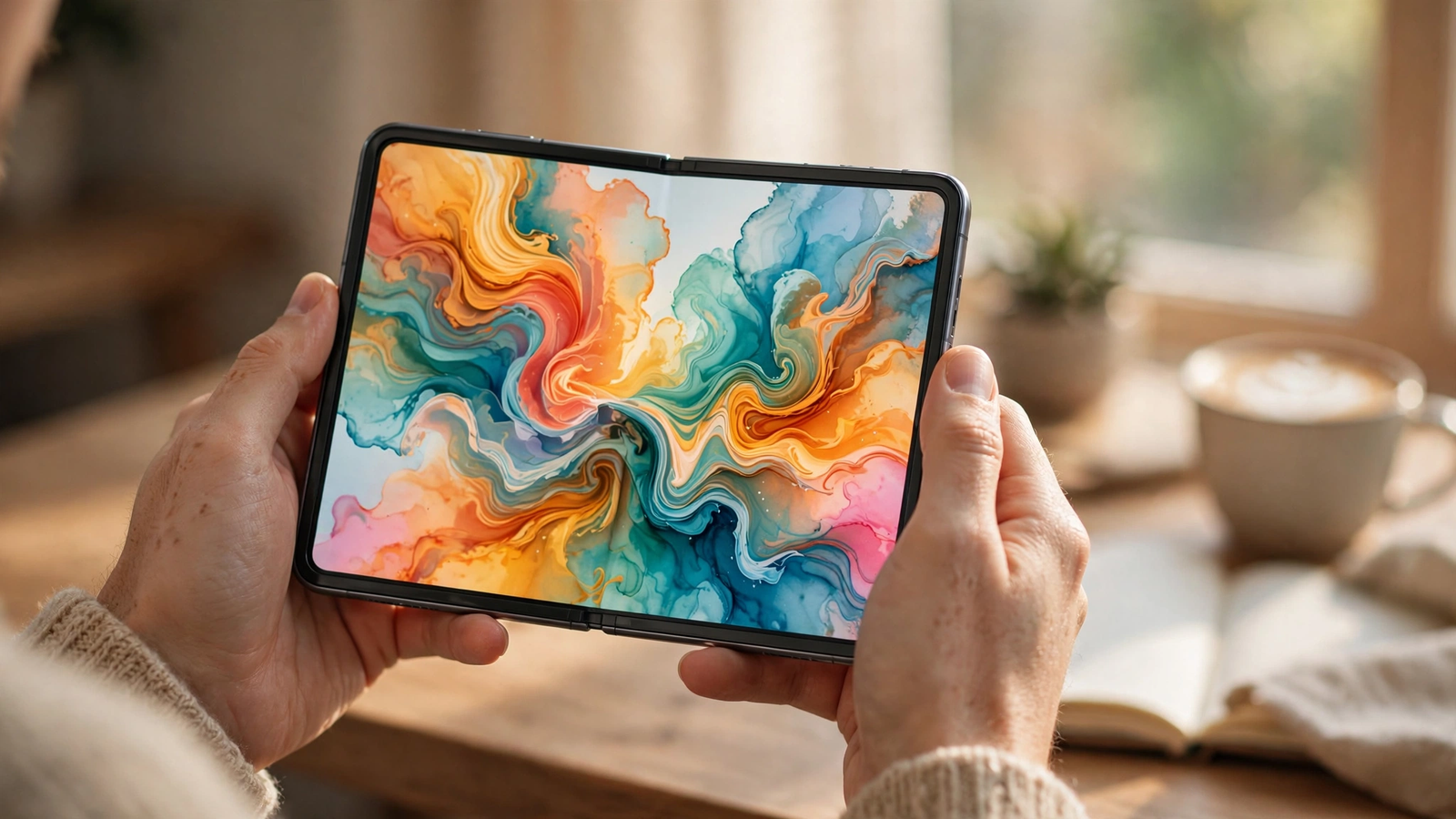
Huawei calls the system Magnetic-Controlled Flattening Technology, and it sits underneath the inner display rather than in the hinge alone. Three parts work together. A 0.1mm magnetic composite layer sits under the folding area, an aerospace-grade steel laminate reinforces the screen, and a 5-micron fill process levels the gap where the panel bends. When the phone opens, the magnetic layer pulls the flexible screen flatter against the frame, instead of leaving it to settle on its own.
The numbers Huawei showed at the launch event are specific. The company says the steel laminate raises bending stiffness by 140 percent and recovers 99.9 percent after bending, while inner-screen flatness improves by 90 percent over the Mate X7. At the event Huawei showed a 3D scan measuring 15 microns between the highest and lowest points of the crease, down from 142 microns on the Mate X7.
There is an honest caveat here, and it comes from Huawei itself. The company’s own care notes say that a visible crease is normal. The magnetic system makes the crease far less noticeable, but it does not erase it completely, and Huawei also claims the crease will not grow more prominent over time. That claim will only be proven once people have used the phone for months.
The phone itself is thinner and lighter than its predecessor. It measures 4.2mm when unfolded and 8.95mm when folded, down from 4.5mm and 9.5mm on the Mate X7. The standard model weighs about 237 grams, while the Collector’s Edition comes in at 239 grams. Huawei says the Mate X8 is lighter than any previous Mate X phone, which matters for a device that is carried closed in a pocket for most of the day.
Two screens, both very bright
The inner display is an 8.2-inch OLED panel with a roughly 1:1 aspect ratio and a 2424 by 2340 resolution. It uses LTPO technology, so the refresh rate can drop to 1Hz or rise to 120Hz depending on what is on screen, and it supports 1440Hz PWM dimming. Huawei rates its peak brightness at 8,000 nits at 1 percent local peak and 4,500 nits at 20 percent, and the screen can dim down to 1 nit for use in the dark.
The cover screen is a 6.54-inch dual-layer OLED panel with a 2444 by 1132 resolution and a 19.4:9 aspect ratio. Its headline number is even bigger: Huawei rates it at up to 12,000 nits at 1 percent APL and 6,000 nits at 20 percent APL. Both panels support HDR Vivid and 1.07 billion colours. The cover uses third-generation Kunlun Glass on the standard model and second-generation Xuanwu Kunlun Glass on the Collector’s Edition.
Those brightness figures need a note of caution. Peak brightness numbers at 1 percent of the screen are measured on a tiny bright patch, not across the whole display, and they do not reflect how bright the screen looks in normal use. Even so, the dual-layer cover panel and the anti-reflective inner display should make the Mate X8 easy to read outdoors.
Kirin 9050 Pro and the biggest battery in a Huawei foldable
Every Mate X8 runs the Kirin 9050 Pro, which Huawei also calls the Logic Folding Tau chip. It is the same processor used in the Mate XT 2 tri-fold, and it is the first time a Huawei foldable has shipped with the company’s top chip across the whole range. Huawei claims overall performance is 31 percent higher than the Mate X7, with a transistor count up 30 percent, a 9-core, 16-thread LinxiCore CPU with 23 percent higher multi-core performance, a Maleoon GPU with second-generation ray tracing and 40 percent higher rendering performance, and a Da Vinci NPU that is 140 percent faster.
Those percentages are Huawei’s own numbers, so they should be read as the company’s claims rather than independent test results. The honest context is that the Kirin 9050 Pro is still thought to be a step or two behind the best Snapdragon and Dimensity processors on raw speed, but it should be competitive with chips like the Google Tensor G6 inside the Pixel 11 Pro Fold.
The battery is the quieter win. The Mate X8 packs a 6,200mAh silicon-carbon battery, the largest Huawei has ever fitted in a single-fold phone, up from 5,500mAh on the Mate X7. It dwarfs the batteries in Samsung’s and Google’s foldables, and it should comfortably last a full day even with the big inner display in use. Charging is 66W wired and 50W wireless, and the phone also carries IP58 and IP59 ratings for dust and water resistance, which is rare for a foldable.
Cameras: variable aperture and a clip-on 1-inch module
The camera system is built around a 50-megapixel main sensor with LOFIC technology and a variable aperture from f/1.4 to f/4.0, which lets the lens open wide for low light or stop down for sharper daylight shots. On the standard model the sensor is 1/1.56-inch, while the Collector’s Edition gets a larger 1/1.28-inch version, and Huawei claims 18EV of dynamic range. All three rear sensors use an RYYB colour filter, which swaps the green filter for yellow to gather more light.
The other two cameras are a 50-megapixel 3.5x periscope telephoto at f/2.2 and a 40-megapixel ultrawide. A third-generation Red Maple sensor joins them for more accurate colour reproduction, and there is an 8-megapixel camera on each screen for selfies and video calls. On the software side Huawei lists batch photo editing, a pro-grade photo editor, LUT support for videos, AI pose recommendations and AI-assisted compositions.
The more unusual camera story is the Ruiying Z10 modular camera. Every Mate X8 supports it: a 1-inch, 50-megapixel RYYB unit with its own optical image stabilisation that attaches to the phone. Huawei is selling a kit with the module, a control handle and a HyperClick connector shell, turning the phone into something closer to a compact camera.
HarmonyOS 7, connectivity and the China-only question
On the software front the Mate X8 ships with HarmonyOS 7 in China rather than Android. The updated system supports split-screen document comparison in WPS Office, the Xiaoyi AI chatbot and a virtual touchpad, and it can warn users about suspicious QR codes. Huawei has not stated a software update policy for the phone.
Connectivity is generous. Huawei has merged the cellular and Wi-Fi antennas, raising the antenna area threefold and signal strength by 2dB. The phone supports Bluetooth 6.0, Wi-Fi 7, USB 3.1 Gen 1 speeds and an IR blaster, and it can hold up to four SIMs at once: two physical SIMs and two eSIMs, with three on standby.
The biggest open question is availability. Huawei has not announced a global release date or international pricing, and the phone may never officially reach Pakistan or other markets outside China. That is the reality of Huawei’s position since the US trade ban in 2019: the hardware is competitive with Samsung and Google, but the software and the distribution stop at China’s border.
Price, colours and sale dates
The Mate X8 comes in five colours: Purple Gold Brocade, Azure Sky Black, Snowy White, Qingyun Brocade and Danxia Brocade. The first three have a brocade pattern design. Prices in China are CNY 12,999, around 1,951 dollars, for 12GB of RAM and 256GB of storage; CNY 13,999, around 2,102 dollars, for 12GB and 512GB; CNY 15,999, around 2,402 dollars, for the 16GB and 512GB Collector’s Edition; CNY 16,999, around 2,552 dollars, for the 16GB and 1TB Collector’s Edition; and CNY 20,999, around 3,152 dollars, for the 16GB and 2TB Collector’s Edition, which is sold only in Purple Gold Brocade and Azure Sky Black.
Pre-orders for the first four configurations opened in China on November 24 at 6:08 p.m. China time. Open sales start at 10:08 a.m. China time on December 4, and the 2TB Collector’s Edition goes on open sale on December 20. Huawei is offering up to 12 months of interest-free installments and a trade-in subsidy of up to CNY 800, around 120 dollars, at its Vmall store, authorised e-commerce sites, experience stores and authorised retailers.
The pricing lands in a difficult market. Industry analysts expect smartphone shipments to fall sharply in 2026 as a memory shortage pushes component prices up, and a foldable starting near 2,000 dollars is a hard sell even in a good year.
What to watch next
The Mate X8 is a strong statement from Huawei: the crease is 90 percent flatter, the battery is the biggest in any Huawei foldable, and the cameras cover everything from ultrawide to 3.5x zoom with a clip-on 1-inch module on top. The December 4 sale date is the first real test, because pre-order numbers and first-week sales will show whether Chinese buyers care enough about the crease fix to pay a premium.
Samsung will not stand still either. Its next flagship is already tipped to improve night photography and video, and the Galaxy S27 series is expected in early 2027 with One UI 9.5 on board. The foldable race in 2027 will be fought on the crease, the battery and the camera, and Huawei has just raised the bar on all three.
Related reading
Vivo X500 India Launch Today: X500, X500 Pro and Pro Max Prices, Specs and Sale Date
Smartphone Shipments Face Record 14% Drop in 2026 as Memory Shortage Bites, Counterpoint Says
Galaxy S27 Ultra Tipped to Improve Night Photography and Video
Frequently Asked Questions
When does the Huawei Mate X8 go on sale?
The Huawei Mate X8 goes on open sale in China on December 4, 2026, at 10:08 a.m. China time. Pre-orders for the first four configurations opened on November 24. The top 2TB Collector’s Edition goes on sale later, on December 20, 2026.
How much does the Huawei Mate X8 cost?
The Huawei Mate X8 starts at CNY 12,999, around 1,951 dollars, for 12GB of RAM and 256GB of storage. The 12GB and 512GB model costs CNY 13,999. Collector’s Edition models cost CNY 15,999 for 16GB and 512GB, CNY 16,999 for 16GB and 1TB, and CNY 20,999 for 16GB and 2TB. These are China prices only.
Does the Huawei Mate X8 really fix the foldable crease?
It improves the crease a lot but does not remove it completely. Huawei’s magnetic flattening system, with a 0.1mm magnetic composite layer and a steel laminate, cuts the crease height from 142 microns on the Mate X7 to as little as 15 microns, a 90 percent improvement in flatness. Huawei’s own care notes say a visible crease is normal, so buyers should expect a much fainter crease, not a perfectly flat screen.
What are the Huawei Mate X8 specifications?
The Mate X8 has an 8.2-inch inner OLED display and a 6.54-inch cover OLED display, both with 1 to 120Hz LTPO refresh rates. It runs the Kirin 9050 Pro chip with 12GB or 16GB of RAM and 256GB to 2TB of storage, a 6,200mAh battery with 66W wired and 50W wireless charging, and a triple rear camera with a 50-megapixel main sensor, a 50-megapixel 3.5x periscope and a 40-megapixel ultrawide. It ships with HarmonyOS 7 and carries IP58 and IP59 ratings.
Will the Huawei Mate X8 launch globally or in Pakistan?
Huawei has not announced a global release date or international pricing for the Mate X8. The launch is China-only for now, and the phone may never officially reach Pakistan or other markets outside China. Buyers outside China would have to import it, with no local warranty and no official local price.
Does the Huawei Mate X8 run Android?
No. The Mate X8 ships with HarmonyOS 7 in China rather than Android. It includes Huawei’s own apps and services, the Xiaoyi AI chatbot and features like split-screen document comparison in WPS Office. Huawei has not announced a global version, so there is no version with Google services.
