


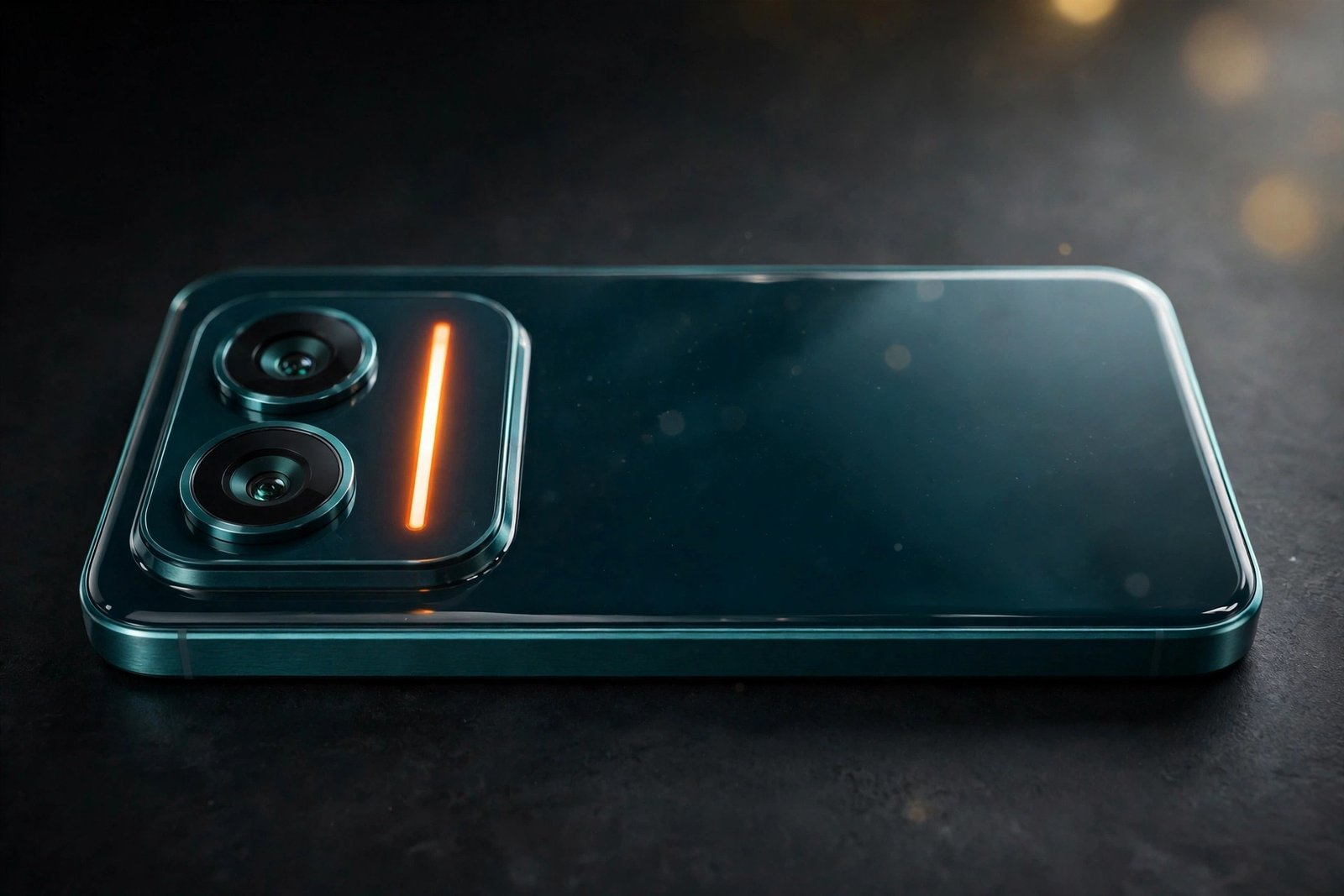
Most phone leaks promise upgrades. This one does not. On November 24, 2026, tipster Abhishek Yadav posted live photos of what he says is the OnePlus Nord 7, along with four key specifications — and while the phone gains a striking new design feature, two of the four specs are a step down from the current Nord 6.
The headline feature is a vertical RGB light strip built into the rear camera module. It is the kind of detail that makes a phone instantly recognisable in a crowded mid-range market, and it is the first thing anyone notices in the leaked photos. But the chip and the display tell a different story: a MediaTek Dimensity 8500 instead of the Nord 6’s Snapdragon 8s Gen 4, and a 144Hz screen instead of 165Hz.
OnePlus has not confirmed the phone, its name, or any of these specifications. Everything in this article comes from the leak and from follow-up reporting by GizmoChina, Memeburn and Gizbot — so treat the details as unconfirmed until OnePlus starts teasing the phone officially.
What the leaked photos show
The photos are the strongest part of the leak. They show a working handset, not a dummy unit or a render, and they reveal several details at once.
The back panel is a glossy dark teal, paired with a teal-green frame. The camera island is large and squarish, sitting in the top-left corner, with two lenses stacked vertically. To the right of the lenses sits a flash and a tall, pill-shaped light strip — glowing orange in one photo and plain and unlit in another.
The front is a flat display with slim bezels and a centred punch-hole selfie camera. One photo shows the lock screen powered on, dated November 23, and it appears to run ColorOS 17 — Oppo’s software — which is another sign that this is a real, working unit rather than a mock-up. OnePlus phones are moving from OxygenOS to ColorOS with the Android 17 update, so ColorOS 17 on the Nord 7 would fit the company’s current software direction.

The leaked specifications
According to the tipster, the OnePlus Nord 7 will feature:
- Chip: MediaTek Dimensity 8500
- Display: 144Hz Super AMOLED
- Battery: 9,000mAh
- Charging: 80W wired
No details have leaked about RAM and storage variants, camera sensors, the front camera, or camera features. The price and launch date are also unknown.
Nord 6 vs Nord 7: what changes on paper
| OnePlus Nord 6 (official) | OnePlus Nord 7 (leaked) | |
|---|---|---|
| Chip | Snapdragon 8s Gen 4 | Dimensity 8500 |
| Refresh rate | 165Hz, 1.5K AMOLED | 144Hz Super AMOLED |
| Battery | 9,000mAh | 9,000mAh |
| Wired charging | 80W | 80W |
| Reverse charging | 27W | Not mentioned |
| Software | Launched on Android 16, getting ColorOS 17 | ColorOS 17 (from photos) |
| Design extra | None | RGB light in camera module |
| India price | From ₹38,999 (about $417) | Not known |
The Nord 6 launched in India on April 7, 2026, at a starting price of ₹38,999. Read the table the other way round and the story is clear: the Nord 7 keeps everything people liked about the Nord 6’s battery, adds a light, and cuts the two specs gamers notice most.
How big is the chip downgrade?
Smaller than it sounds, but real. The Dimensity 8500 uses eight Cortex-A725 cores, the fastest running at 3.4GHz, with a Mali-G720 graphics chip, according to MediaTek’s own specification page. The Nord 6’s Snapdragon 8s Gen 4 pairs a stronger Cortex-X4 prime core with Qualcomm’s Adreno 825 graphics.
Published benchmark tests on two Poco phones running these chips give a sense of the gap. In AnTuTu 11, the Snapdragon 8s Gen 4 scored 2,326,902 overall against 2,110,684 for the Dimensity 8500-Ultra — roughly 10 percent ahead. The graphics gap is wider: 811,300 against 655,088, about 24 percent in Qualcomm’s favour. The same tests also put the Snapdragon about 27 percent ahead in Geekbench single-core performance.
In daily use, a 10 percent overall gap is hard to feel. Scrolling, messaging, streaming and photography will feel the same on either chip. But the roughly 24 percent graphics gap should show up in long 3D gaming sessions, where the Nord 6 should hold higher frame rates for longer.
This is less a downgrade than a sideways move. The Dimensity 8500 is a strong upper-mid-range chip — it is the same family Poco uses in the X8 Pro — but it is not the step up you would expect from a new generation.
165Hz to 144Hz: will you notice?
Refresh rate is how many times per second the screen redraws. A higher number makes scrolling and fast games look smoother. At 144Hz the screen shows a new frame every 6.9 milliseconds, against 6.1 milliseconds at 165Hz — a difference of under one millisecond.
Most people will not see that difference in everyday scrolling. Competitive mobile gamers might, but only in the few games that actually run above 144 frames per second. The bigger open question is resolution: the tipster did not say whether the Nord 7 keeps the Nord 6’s 1.5K panel. If it drops to Full HD, that would be a more noticeable change than the refresh rate.
What could the RGB light be for?
The purpose of the light is not known. The photos show it glowing orange, and the most likely uses are notifications, charging progress and gaming effects. Some reports also suggest it could react when you talk to an AI assistant, though that is speculation for now.
It is a small hardware change, but it gives the Nord 7 an instantly recognisable back, which matters for a brand that now competes mostly in India’s crowded mid-range market. The open question is whether OnePlus lets you customise the light or switch it off — a light you cannot disable gets old fast.
The idea is not entirely new. Poco’s X8 Pro already pairs a Dimensity 8500-series chip with RGB lighting around its camera, and it launched in India at ₹32,999 — about ₹6,000 below the Nord 6’s starting price. OnePlus may be aiming at the same buyer.
Why would OnePlus step sideways?
OnePlus has not explained anything yet, so this is analysis rather than fact — but there are three plausible reasons.
First, memory and chip costs are up. The global RAM shortage has pushed phone prices up all year, and a cheaper chip is one way to hold the Nord’s price or limit how much it rises.
Second, MediaTek is genuinely competitive at this tier. The Dimensity 8500 is close enough to Snapdragon’s 8s line that brands can save money without a large real-world penalty.
Third, there is a proven template. The Poco X8 Pro shows that a Dimensity 8500 phone with RGB lighting can sell well at a lower price, and OnePlus may want to compete more directly with it.
The most likely outcome is a Nord 7 that costs about the same as the Nord 6 while giving up a little speed. If OnePlus cuts the price instead, the trade-off makes much more sense for buyers.
Is the Nord 7 just a renamed Turbo 7?
That is the confusing part. OnePlus’s China-only Turbo phones have been reborn as Nords before: the Turbo 6 became the Nord 6 in India. Earlier rumours said the Nord 7 would follow the same path, but the leaked OnePlus Turbo 7 points to a Snapdragon chip, a 200MP camera and a battery of around 10,000mAh. None of that matches the tipster’s specs.
There are two possible explanations. Either OnePlus has changed direction for the Nord 7, or these photos show a different phone — possibly a Nord CE model — that ends up with another name. Until OnePlus starts its teasers, both are plausible.
Where and when could it launch?
OnePlus has not given a date. The Nord 6 launched on April 7, 2026, and some reports point to early 2027 for its successor. A similar spring window would fit, but that is a guess.
Markets are clearer. OnePlus stopped launching new products in North America and Europe in July 2026, so the Nord 7 is very likely an India and Asia phone. If you are in the US or UK, you would need to import it — without a local warranty, and possibly missing some local network bands.
Should you wait for it?
If you own a Nord 6, this leak gives you little reason to upgrade. The battery and charging are the same, the chip and screen are a step sideways at best, and the RGB light is a design flourish rather than a functional upgrade.
If you are shopping for a new mid-range phone now, the Nord 6 remains the stronger phone on paper — and its price may fall once the Nord 7 is officially announced. The Nord 7 only becomes the better buy if OnePlus prices it below the Nord 6, which the cheaper chip makes possible.
The Nord 7 leak tells you as much about the market as about OnePlus. In 2026, a new mid-range phone does not automatically mean a faster one, and the spec sheet is now a balancing act between price, battery and the parts that cost the most.
Frequently asked questions
When will the OnePlus Nord 7 launch?
OnePlus has not announced a launch date. The Nord 6 launched on April 7, 2026, and reports point to early 2027 for its successor, but that is an estimate, not an official date.
What are the leaked OnePlus Nord 7 specifications?
Tipster Abhishek Yadav claims the Nord 7 will have a MediaTek Dimensity 8500 chip, a 144Hz Super AMOLED display, a 9,000mAh battery and 80W wired charging. OnePlus has not confirmed any of these specs.
What is the RGB light on the OnePlus Nord 7?
Leaked live photos show a vertical RGB light strip inside the rear camera module, glowing orange in one photo. Its exact purpose is unknown, but it is likely to be used for notifications, charging progress or gaming effects.
Is the OnePlus Nord 7 slower than the Nord 6?
On paper, yes — slightly. The leaked Dimensity 8500 scores about 10% lower than the Nord 6’s Snapdragon 8s Gen 4 in AnTuTu overall, and about 24% lower in graphics tests. In everyday use the difference will be hard to notice, but heavy gamers may see lower frame rates.
Will the OnePlus Nord 7 launch in the US or Europe?
Almost certainly not officially. OnePlus stopped launching new products in North America and Europe in July 2026, so the Nord 7 is expected to be an India and Asia phone. Buyers elsewhere would need to import it without a local warranty.
How much will the OnePlus Nord 7 cost?
The price is not known. The Nord 6 launched in India from ₹38,999 (about $417). Because the leaked Dimensity 8500 chip is cheaper than the Snapdragon in the Nord 6, the Nord 7 could launch at a similar or slightly lower price.
Sources: GizmoChina (Nov 24, 2026), Memeburn (Nov 26, 2026), Gizbot (Nov 26, 2026); live photos by tipster Abhishek Yadav.
