


Google’s November 2026 Pixel update fixed dozens of bugs, but one privacy problem slipped through. A bug that unhides a hidden Private Space in the app drawer is still present after the update, and the trigger is something millions of Pixel owners do every day: switching between light and dark mode.
Android Authority reported the problem on November 13, 2026, after reproducing it on a Pixel 8 running the November update and recording the result on video. PhoneArena confirmed the same behaviour a day later, and Pixel owners on Reddit say they see it on the Pixel 10 and Pixel 10 Pro too. Google has not announced a fix date, and until one arrives, the only reliable protection is to stop the phone from switching themes on its own.
Summary
- A bug in Android 17 makes a hidden Private Space reappear in the app drawer when a Pixel switches between light and dark mode.
- Android Authority reproduced the bug on a Pixel 8 running the November 2026 update, and the bug is still present in Android 17 QPR2.
- The problem first surfaced after Android 17 QPR1 in September 2026, and it has now survived two monthly updates.
- Scheduled dark mode can trigger it silently, so the hidden folder can reappear without the owner ever touching the theme setting.
- Google has passed a related Issue Tracker report to its development team, but it has not confirmed a fix date for this exact trigger.
- The workaround is to turn off scheduled dark mode and keep the phone on one theme until Google ships a fix.
What Private Space is — and why this bug matters
Private Space arrived with Android 15 as a locked, sandboxed area inside the app drawer. It is designed for apps and files the owner does not want anyone else to see: banking apps, health apps, private photos, work documents. The space sits at the bottom of the app drawer, behind its own lock, and owners can go one step further and hide it completely, so the section does not appear in the drawer at all.
That hiding option is the whole point for many users. A locked folder that is visible still invites questions; a folder that does not appear at all gives nothing away. Private Space is meant to be invisible until the owner deliberately opens it, and that is exactly what this bug breaks.
When the bug triggers, the hidden section pops back into the app drawer at the bottom, visible to anyone who opens it. The apps inside remain locked, so the contents are not immediately exposed, but the privacy the feature promises — that nobody can tell the space exists — is gone. For a feature whose job is discretion, that is a real failure, not a cosmetic glitch.
What the bug does
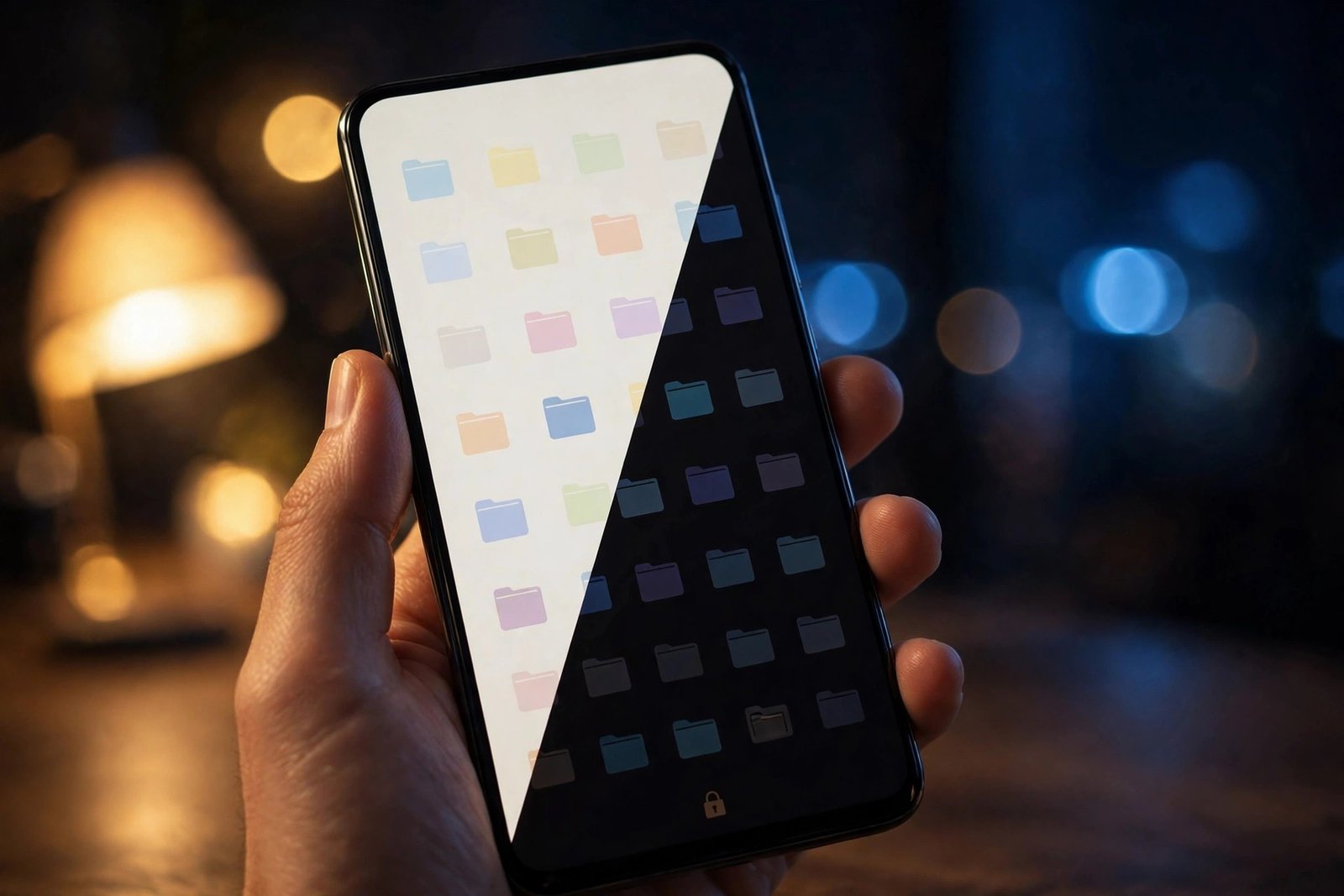
The behaviour is simple and easy to reproduce. A Pixel owner hides Private Space from the app drawer, then switches the phone’s theme. In light mode the space stays hidden; flick to dark mode and it shows up at the bottom of the drawer. Flick back to light mode and it keeps showing. The section does not re-hide itself.
Worse, the owner does not need to switch themes manually. Android’s scheduled dark mode — the setting that flips the theme at sunset, at sunrise, or on a fixed timetable — triggers the same fault. That means the hidden space can reappear overnight, while the phone sits untouched on a bedside table, and the owner may not notice until someone else opens the app drawer. Android Authority specifically flagged this: a scheduled theme change can undo the hiding without the owner doing anything at all.
The bug is not limited to one phone. Android Authority recorded it on a Pixel 8 running the November update, and PhoneArena reports that two Reddit commenters confirmed the same issue on the Pixel 10 and Pixel 10 Pro. Those are user reports rather than official confirmation, but the pattern is consistent across models and across the current Pixel range.
A bug that has survived two updates
This is not a new problem that arrived with the November update. It first surfaced after Android 17 QPR1 landed in September 2026, and it is still there in Android 17 QPR2, which Google shipped on November 10, 2026, bundled with the November Pixel Drop and the monthly security patch. Two monthly updates, and the bug is still present.
The history on Google’s Issue Tracker is tangled, which partly explains why it is still unfixed. The first report of Private Space reappearing dates back to May 2026, but that report did not mention light and dark mode at all, and Google marked it as fixed on May 28. Then, on October 24, a new report appeared that named the theme trigger specifically: “Private bar shows after switching between light and dark mode.” There has been no reaction from Google to that report since it was filed.
A separate Issue Tracker complaint describes Private Space randomly appearing even after being hidden, without naming the theme trigger. That one did get a reply from a Google engineer: “Thanks for reporting this issue. We have passed this to the development team and will update this issue with more information as it becomes available.” It is the closest thing to an acknowledgement so far, but it does not confirm that Google has reproduced the light-and-dark-mode trigger, and it comes with no fix date.
Android Authority says it has asked Google whether the company is aware of the issue and whether a fix is coming. As of November 15, 2026, Google has made no public statement and no fix date has been announced.
Motorola’s Razr 50 Ultra just got stable Android 17 in Europe.
Why the November update missed it
The November update was a large one. Google combined the monthly Android security patch with roughly 33 functional bug fixes spanning camera, battery, Bluetooth and user-interface issues, and bundled Android 17 QPR2 into the same release, about a month ahead of its usual quarterly schedule. Most devices received build CP4A.261105.040.A1, taking them to the November 5, 2026, security patch level.
Yet none of that touched the Private Space bug. The most likely explanation is the tangled Issue Tracker history: an earlier, related report was marked fixed in May, before the theme trigger was identified, so the specific light-and-dark-mode fault may not have been on the fix list for November at all. That is speculation, though — Google has not said why the bug survived, and the company has not confirmed the theme trigger in any public statement.
What is certain is that the bug is easy to verify and easy to reproduce, and it affects a feature that exists specifically to protect privacy. Owners who rely on a hidden Private Space should treat the November update as no protection at all against this particular problem.
Gmail’s settings are getting the same Material 3 Expressive treatment.
The workaround: stop the theme from switching
Until Google ships a fix, the practical answer is to remove the trigger. If the phone never switches between light and dark mode, the bug has nothing to act on. That means two changes in settings:
First, turn off scheduled dark mode. Open Settings, go to Display & touch, then Dark theme, then Schedule, and choose None. This stops the phone from flipping themes at sunset or on a timetable, which is the silent trigger that can re-expose the hidden space without the owner noticing.
Second, pick one theme and stay on it. Leave the phone in light mode or dark mode — whichever is preferred — and avoid switching manually. With no theme change, the hidden space should stay hidden.
If the space has already reappeared, re-hide it after locking it, then check the app drawer after the next theme change to confirm it stays hidden. These steps are workarounds, not a repair: they stop the bug from triggering, but they do not fix the underlying fault. The only real fix will be a software update from Google, and there is no date for that yet.
Owners should also remember that the apps inside Private Space remain locked even when the section is visible, so the contents are not immediately exposed. The risk is that the existence of the hidden space becomes visible, which defeats the purpose of hiding it in the first place.
How to check if your Pixel is affected
The test takes less than a minute, and it is worth doing before deciding whether to change any settings. First, make sure Private Space is set to stay hidden: open the app drawer, scroll to the bottom, and confirm the section is not visible. Then switch the theme — if the phone is in light mode, turn on dark mode, or the other way round — and open the app drawer again. If the Private Space section has appeared at the bottom of the drawer, the phone is affected. Switch the theme back and check once more: on affected phones the section stays visible even after returning to the original theme.
Owners who use scheduled dark mode should also check the drawer first thing in the morning, after the phone has switched themes overnight. If the space is visible, it has been exposed since the last scheduled switch, and the workaround in the next section is worth applying straight away. The check costs nothing and it settles the question for a specific phone, rather than relying on reports from other models.
What to watch next
The next signal will be Google’s December update, or a smaller fix release before it. If the bug is fixed, the change should appear in the update’s release notes or in the Issue Tracker thread, where the Google engineer promised an update when more information becomes available. Until then, owners can check whether their phone is affected by hiding Private Space, switching themes once, and looking at the bottom of the app drawer.
The wider lesson is worth noting too. Private Space is a privacy feature, and privacy features are judged differently from other software: a bug that reveals a hidden folder is more serious than a bug that misplaces an icon, because the whole point of the feature is that nobody else knows it is there. Google’s November update fixed dozens of issues, but for owners who depend on Private Space, the one it missed is the one that matters most.
Google’s other Pixel settings change this month adds a Family Hub to Pixel settings.
FAQs
Is the Pixel Private Space bug fixed in the November 2026 update?
No. Android Authority reproduced the bug on a Pixel 8 running the November 2026 update and recorded it on video, and Reddit users report the same issue on the Pixel 10 and Pixel 10 Pro. The bug first appeared after Android 17 QPR1 in September 2026 and is still present in Android 17 QPR2, which shipped with the November update. Google has not announced a fix date.
What exactly triggers the Private Space bug?
Switching a Pixel between light and dark mode makes a hidden Private Space reappear in the app drawer, even when it is set to stay hidden. The space appears at the bottom of the drawer when the theme changes to dark mode, and it stays visible after switching back to light mode. Scheduled dark mode can trigger it automatically, without the owner touching the theme setting.
Which Pixel phones are affected by the Private Space bug?
Android Authority confirmed the bug on a Pixel 8 running the November 2026 update. Reddit users have also reported it on the Pixel 10 and Pixel 10 Pro, though those are user reports rather than official confirmation. The bug is tied to Android 17 QPR1 and QPR2 rather than to one specific phone model, so any Pixel running those builds with a hidden Private Space could be affected.
How do I stop Private Space from reappearing on my Pixel?
Turn off scheduled dark mode and keep the phone on one theme. Go to Settings, then Display & touch, then Dark theme, then Schedule, and choose None, so the phone stops switching themes by itself. Then pick light mode or dark mode and stay on it. This removes the trigger, but it is a workaround, not a fix — the underlying bug remains until Google ships a software update.
Has Google acknowledged the Private Space bug?
Google has replied to a related Issue Tracker report, saying it has passed the issue to the development team and will update the report with more information. However, that report describes Private Space reappearing at random and does not name the light-and-dark-mode trigger specifically. Google has not publicly confirmed this exact bug or given a fix date, and Android Authority says it has asked Google for a statement.
Sources: Android Authority, ‘Google Pixel Private Space bug persists after November update’ (Rita El Khoury), November 13, 2026; PhoneArena, ‘Your Google Pixel might be exposing something you thought was private’, November 14, 2026.
