


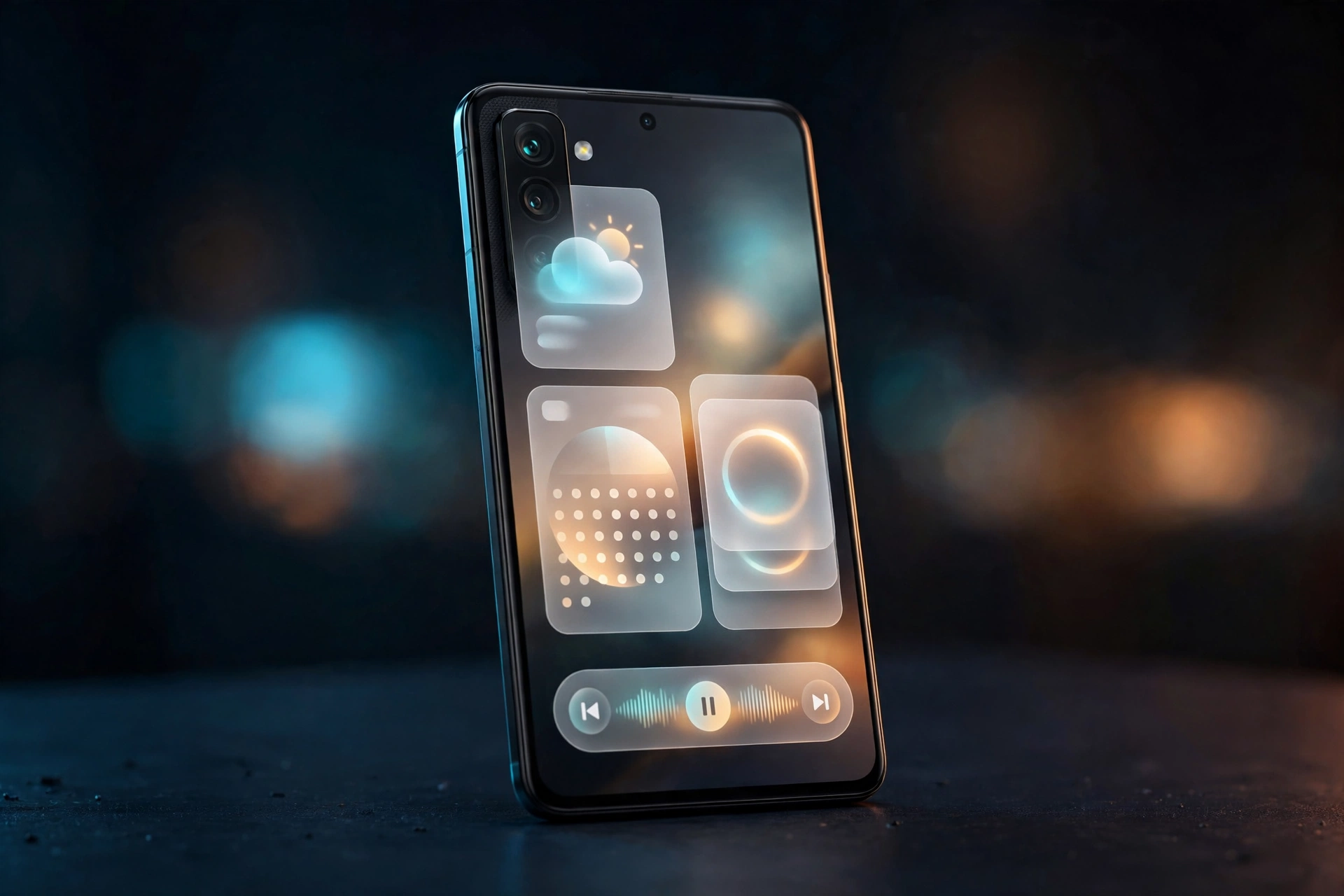
Xiaomi’s biggest software rollout of the year has reached its second phase — on paper, at least. The company’s global HyperOS 4 schedule moves into its mid-November wave on November 15, 2026, opening the update to a second group of Xiaomi, Redmi and POCO phones and tablets. But a week and a half after the rollout began, the gap between Xiaomi’s calendar and what owners can actually install is hard to ignore: as of November 15, only three phones have a public HyperOS 4 build outside China.
That does not make the update a non-event. HyperOS 4 is one of the largest Android rollouts of 2026, covering 82 phones and tablets across three waves that run from early November into December, according to the schedule Xiaomi published on November 3. It brings a new glass-style interface, a smarter AI assistant, measurable performance gains and deeper links between Xiaomi’s phones, tablets and other devices. For owners of the phones on the list, it is the most significant update their device will get this year.
Xiaomi announced the global schedule through its official HyperOS account on X and on its global HyperOS 4 page on mi.com, following a global beta programme that began in September. The update is built on Android 17 for most devices, though Xiaomi says the Android base can vary by model — some phones already received Android 17 under HyperOS 3. In China, where the software runs on a separate track, stable HyperOS 4 began rolling out on October 15, starting with the Xiaomi 17, Redmi K90 and Pad 8 lines.
Summary
- The news: Xiaomi’s global HyperOS 4 rollout enters its second wave on November 15, 2026. The schedule covers 82 Xiaomi, Redmi and POCO phones and tablets in three waves running through December.
- Wave 2 devices: The mid-November group includes the Xiaomi 15T Pro and 15T, the POCO F9 Ultra, F9 Pro and F7 series, the POCO X7 Pro, the Xiaomi Pad 7 series and Pad Mini, the Redmi Pad 2 Pro and the POCO Pad X1 and Pad M1.
- The catch: As of November 15, only three phones have a public HyperOS 4 build outside China — the POCO F8 Pro, the POCO F8 Ultra and the Xiaomi 17 — according to firmware tracking. The rest of the first wave is still waiting.
- What’s new: A translucent “Soft Light Glass” design, a multi-step AI assistant, faster app launches and steadier frame rates in Xiaomi’s own lab tests, and new cross-device features.
- The AI split: The most advanced assistant features, built on Xiaomi’s MiMo model, are tied to Chinese software builds for now. Global devices get Xiaomi’s HyperAI tools instead, with some features arriving in stages.
- India: Xiaomi has not published a separate India schedule. Indian devices follow the same global timeline, and no Indian build had appeared as of November 15.
A New Look Built on Glass
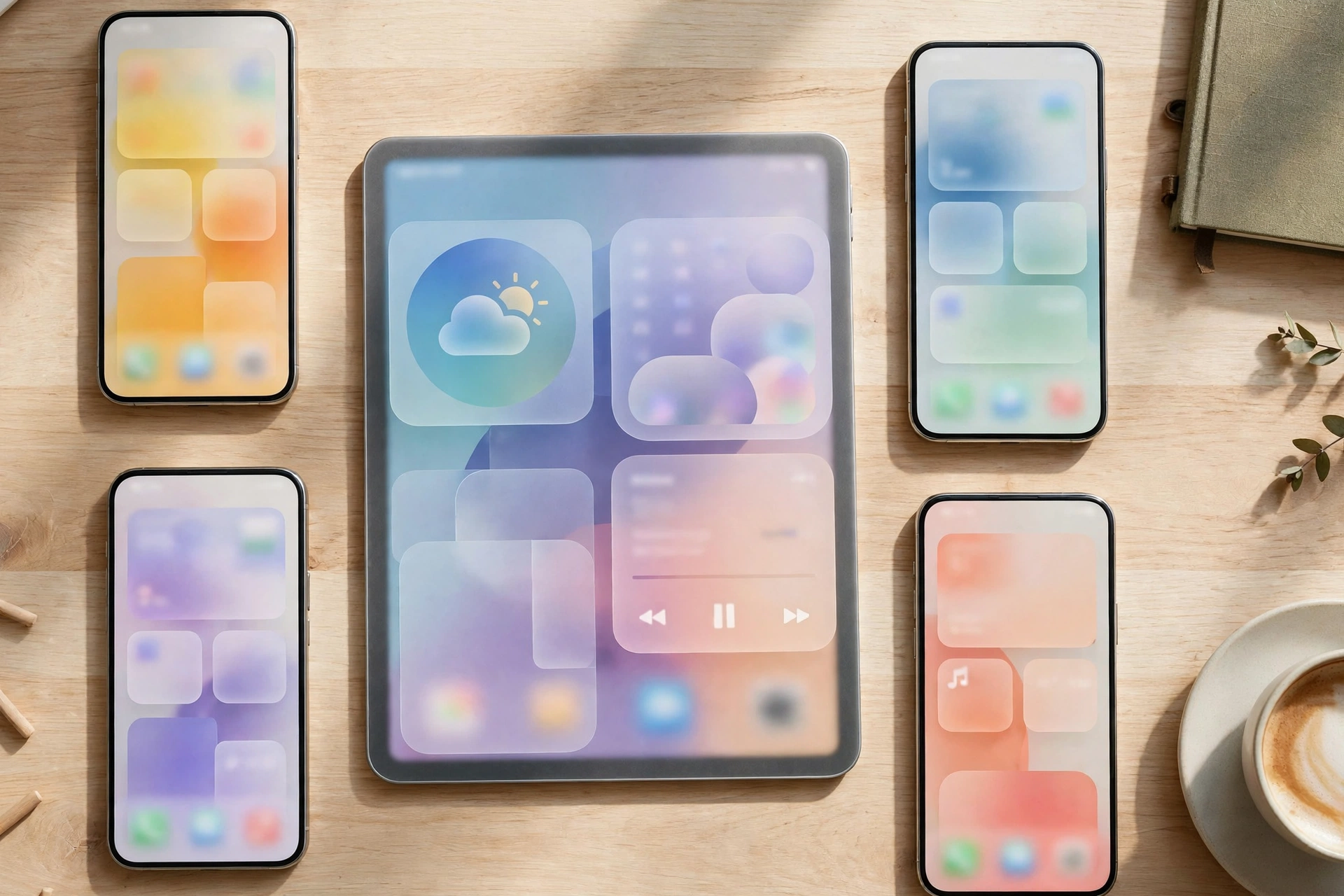
The most visible change in HyperOS 4 is its design. Xiaomi calls the new look “Effortless Aesthetics”, and it is built around soft glass: translucent panels, blurred backgrounds and light effects across icons, folders and the lock screen. Android Authority, which covered the global schedule, describes it as a “Soft Light Glass” design with layered notifications, redesigned lock screens and more customisation options. The resemblance to Apple’s glass-style interface has not gone unnoticed — Android Authority’s own coverage opens by noting that Apple may have trademarked the art of making glass look exciting on phones — but Xiaomi is presenting the look as its own, and it reaches far beyond a coat of paint.
The redesign changes how the interface behaves, not just how it looks. Folders resize more easily, widgets group together more readily, and switching between portrait and landscape orientations is smoother, according to Analytics Insight’s breakdown of the update. The lock screen gets new layouts, and notifications are stacked in layers rather than laid out flat. On flagship silicon — phones running the Snapdragon 8 Elite, MediaTek’s Dimensity 9500 or Xiaomi’s own 3nm XRING O1 processor — the heaviest real-time glass refraction effects are available in full; on other devices the look is the same idea with lighter effects. It is the first thing every user will notice the moment the update installs.
An Assistant That Does the Task, Not Just Opens the App
The deeper change sits underneath the design. In China, HyperOS 4 ships with Super XiaoAI 2.0, an assistant built on Xiaomi’s own MiMo language model that can follow instructions with several steps at once. Ask it to find a photo, crop it and share it, and it treats that as one request instead of three separate ones. A new Expert Mode lets the assistant work inside supported apps rather than simply opening them, and AI Voice Notes turns a recording into a short summary, a list of action items or a simple mind map.
That is the version of the assistant Xiaomi is showing off in China. Outside China, the picture is different, and Xiaomi has not hidden the gap. Super XiaoAI 2.0 and its MiMo-based features are tied to Chinese software builds for now. Global devices run Xiaomi’s HyperAI tools instead, and some AI features will arrive gradually through later updates rather than with the first release. Analytics Insight’s coverage is explicit on this point: the two assistant rollouts are not the same, and the experience outside China may look different.
It is worth being clear about what that means in practice. Owners outside China will get the new design, the performance work and the cross-device features with HyperOS 4. The most advanced multi-step assistant behaviour may not arrive with it, or may arrive later and in a different form. That is a real limitation of this rollout, and Xiaomi has not put a date on it.
Faster, According to Xiaomi’s Own Tests
Xiaomi backs its performance claims with internal test data, and the numbers are specific. In tests on the Xiaomi 17 Ultra comparing HyperOS 3 with HyperOS 4 after nine hours of active use, launching 30 apps took 36.8 seconds on the new version against 40.3 seconds on the old one. The average frame drop rate fell from 2.92 percent to 1.10 percent. Camera cold launch — the time from tapping the camera icon to the viewfinder being ready — dropped from 1,043.6 milliseconds to 808.8 milliseconds.
These are lab results on one flagship, not a guarantee of identical gains on every phone. A budget Redmi will not see the same numbers as a Xiaomi 17 Ultra, and real-world use — with different apps, storage states and network conditions — will vary. But the direction is consistent across all three measurements: faster app loading, steadier playback and a quicker camera.
Devices That Work Together
HyperOS 4 also pushes Xiaomi’s cross-device system further. HyperConnect, the company’s device-linking layer, now lets one Xiaomi device control the camera of another connected device, and lets a tablet share a phone’s mobile data directly. These are specific, confirmed functions rather than a broad promise of moving any task across any two screens, and they matter most for owners who already have more than one Xiaomi device — a phone and a Pad, for example.
Privacy gets two new layers as well. Xiaomi describes “quantum-level encryption” that uses advanced cryptography designed to withstand quantum-computing threats, though it applies only to key exchange within specific end-to-end encrypted scenarios. A second layer, Edge-to-Cloud AI Data Security, covers on-device storage security and safe data transfer. The details here are thin — Xiaomi has not published a full technical breakdown — so owners should treat these as described features rather than independently verified protections.
The Three Waves: Who Gets It and When
The rollout is divided into three waves, and Xiaomi’s own fine print matters: these are the dates each wave starts, not the dates every phone in the wave gets the update. Availability varies by device and region, and the schedule is, in Xiaomi’s words, estimated and subject to change based on region, carrier, model and research and development progress.
The first wave began in early November. It covers the Xiaomi 17 Ultra, the Leica Leitzphone powered by Xiaomi, the Xiaomi 17, 17T Pro and 17T, the Xiaomi 15 Ultra and 15, the Redmi Note 17 Pro Max 5G, Note 17 Pro 5G, Note 17 5G and Note 17, the Redmi Note 15 Pro+ 5G, Note 15 Pro 5G, Note 15 Pro, Note 15 5G and Note 15, the Redmi 17 5G, 17, 17C 5G, 15C 5G and 15C, the POCO F8 Ultra and F8 Pro, the POCO X8 Pro Max, X8 Pro, X8 Pro Iron Man Edition and X8, the POCO M8 Pro and M8, the POCO C95 Pro and C85, and the Xiaomi Pad 8 Pro and Pad 8.
The second wave starts in mid-November — effectively November 15 — and covers the Xiaomi 15T Pro and 15T, the POCO F9 Ultra and F9 Pro, the POCO F7 Ultra, F7 Pro and F7, the POCO X7 Pro and X7 Pro Iron Man Edition, the Xiaomi Pad 7 Pro, Pad 7 and Pad Mini, the Redmi Pad 2 Pro 5G and Redmi Pad 2 Pro, and the POCO Pad X1 and Pad M1. Android Authority lists 16 devices in this wave; Xiaomi’s own website lists 19, and the two do not agree on every model.
The third wave arrives in December and is the largest. It covers the Xiaomi MIX Flip, the Xiaomi 14 Ultra and 14, the Xiaomi 13 Ultra, 13 Pro and 13, the Xiaomi 14T Pro and 14T, the Xiaomi 13T Pro and 13T, the Redmi Note 14 Pro+ 5G, Note 14 Pro 5G, Note 14 Pro, Note 14 5G and Note 14, the Redmi 15 5G and 15, the Redmi 14S and Redmi A7 Pro, the POCO F6 Pro and F6, the POCO X8s, X7 and X6 Pro, the POCO M8s 5G and M7, the POCO C81 Pro, the Xiaomi Pad 6S Pro 12.4, the Redmi Pad 2 line and the POCO Pad C1. The Xiaomi 18 and 18 Pro, which ship with HyperOS 4 out of the box, sit outside the three waves.
Not every Xiaomi phone makes the cut. Several popular 2023 and early-2024 models are left out, including the Redmi Note 13 Pro+ and the POCO X6 5G. Owners of those phones will stay on their current software, and Xiaomi has not announced a later wave for them.
The Rollout So Far: A Schedule Ahead of the Software
Here is where the story gets complicated. Xiaomi’s schedule says the second wave starts on November 15. Firmware tracking tells a different story about what has actually shipped. According to XiaomiFirmware’s rollout status page, updated November 15, nothing new has been released outside China since November 11. Only three phones have a HyperOS 4 build on Xiaomi’s servers for international regions: the POCO F8 Pro on a global stable build, the POCO F8 Ultra on a European stable build, and the Xiaomi 17 on global and European pilot builds. The POCO X8 Pro Max, the Xiaomi 17T Pro and 17T, and the rest of the first wave are still waiting.
There are signs of movement. On November 14, Xiaomi compiled new internal HyperOS 4 test builds for dozens of global models, which usually comes before a public release. But internal test builds are not updates owners can install, and no phone in India had a HyperOS 4 build at all as of November 15.
There is also a discrepancy inside Xiaomi’s own announcement. On November 3 and 4, the company published the global schedule twice: as an image on its HyperOS account on X, and on the HyperOS 4 page on mi.com. Both list the same 82 devices, but seven phones sit in different waves between the two versions — the Xiaomi 15, Xiaomi 15 Ultra, POCO X8 and the four Redmi Note 17 models are in the early-November wave in the X post and in the mid-November wave on mi.com. The X post counts 33 devices for early November and 16 for mid-November; mi.com has 26 and 23. December is the same in both. Xiaomi has not corrected either version, and most English-language coverage — including Android Authority, GSMArena and 9to5Google — repeated the X post’s split.
None of this means the rollout has stalled. Xiaomi said from the start that the dates are when each wave begins, not when every phone gets the update, and that the rollout would continue over several weeks. But owners should not expect the update the day their wave starts. The first wave’s experience so far — a schedule that began in early November and three public builds by November 15 — is a better guide to the pace than the calendar alone.
How to Check for the Update
Owners of eligible phones can check manually rather than waiting for a notification. On a Xiaomi, Redmi or POCO phone, open Settings, then About phone, then tap the HyperOS version to check for an update. If nothing appears, the update has not reached that device and region yet, and there is nothing to force — Xiaomi rolls these updates out in batches, and repeatedly checking does not speed it up.
Before installing, it is worth backing up important photos and files, as with any major software update, and installing over Wi-Fi rather than mobile data. Once installed, the glass redesign and the new lock screen layouts will be the first things to notice; the assistant and performance changes will take longer to judge.
What Is Still Unclear
A few things about this rollout remain unresolved. Xiaomi has not said when the China-only Super XiaoAI 2.0 features will reach global devices, or whether they will arrive in the same form. The company has not corrected the disagreement between its X post and its website about which wave seven models belong to, so owners of the Xiaomi 15, Xiaomi 15 Ultra, POCO X8 and the Redmi Note 17 series cannot be sure from Xiaomi’s own pages whether they are in wave one or wave two. And there is no separate schedule for India, where no HyperOS 4 build had appeared at all as of November 15.
The Xiaomi 18 series, which ships with HyperOS 4 pre-installed, is a separate story. The Xiaomi 18 Pro is set for its global launch in Paris on November 17, and its rear display already runs Google Maps, Spotify and YouTube Music ahead of that launch. For owners of older Xiaomi phones, though, the update that matters is the one arriving over the air — and for most of them, the wait is not over yet.
The pattern is familiar from other manufacturers. Samsung’s Galaxy A15 5G is also receiving its Android 17 update in stages, with carrier-locked models first and other variants following. Big rollouts rarely land everywhere at once, and Xiaomi’s is no exception. The schedule is real, the features are real, and the first builds are real. The pace is simply slower than the calendar suggests — and for the 82 devices on the list, the next few weeks will show whether wave two moves any faster than wave one did.
Is HyperOS 4 available on my phone yet?
It depends on your model and region. The global rollout covers 82 Xiaomi, Redmi and POCO phones and tablets in three waves from early November to December 2026. As of November 15, only three phones — the POCO F8 Pro, POCO F8 Ultra and Xiaomi 17 — had a public HyperOS 4 build outside China, so most owners on the list are still waiting even if their wave has started.
Which devices get HyperOS 4 in wave 2?
The mid-November wave, starting November 15, includes the Xiaomi 15T Pro and 15T, the POCO F9 Ultra, F9 Pro, F7 Ultra, F7 Pro and F7, the POCO X7 Pro, the Xiaomi Pad 7 Pro, Pad 7 and Pad Mini, the Redmi Pad 2 Pro and the POCO Pad X1 and Pad M1. Android Authority lists 16 devices in this wave; Xiaomi’s own website lists 19, and the two do not agree on every model.
Does HyperOS 4 run on Android 17 for every device?
Most supported devices move to Android 17, but the exact Android version can differ by model. Some phones already received Android 17 under HyperOS 3, so for those the update is mainly Xiaomi’s own design, AI and performance changes rather than a new Android version. Check your phone’s update notes rather than assuming every device gets an identical software base.
Is Super XiaoAI 2.0 available outside China?
Not in its full form yet. Super XiaoAI 2.0 and its MiMo-based features are tied to Chinese software builds for now. Global devices run Xiaomi’s HyperAI tools instead, and some AI features will arrive gradually through later updates rather than with the first release. Xiaomi has not given a date for the full assistant to reach global devices.
When will HyperOS 4 reach India?
Xiaomi has not published a separate India-specific schedule. Indian devices follow the same general global rollout timeline, though the exact date still depends on the phone model and carrier. As of November 15, no phone had an Indian HyperOS 4 build.
Sources: Android Authority, “HyperOS 4 global rollout begins: Here’s when your phone gets it” (November 3, 2026); Analytics Insight, “Xiaomi HyperOS 4 Features, AI Upgrades and Performance” (November 15, 2026); XiaomiFirmware, “HyperOS 4 Rollout Status: Which Phones Have It” (updated November 15, 2026).
Caveats: The “only three public builds” figure and the mi.com vs X-post wave discrepancy come from XiaomiFirmware’s independent tracking of Xiaomi’s update servers, not from Xiaomi itself. The performance figures are Xiaomi’s own internal lab tests on the Xiaomi 17 Ultra, not independent measurements. Xiaomi has not corrected the conflicting wave assignments for seven models, and no completion date has been given for the rollout or for global availability of Super XiaoAI 2.0.
