


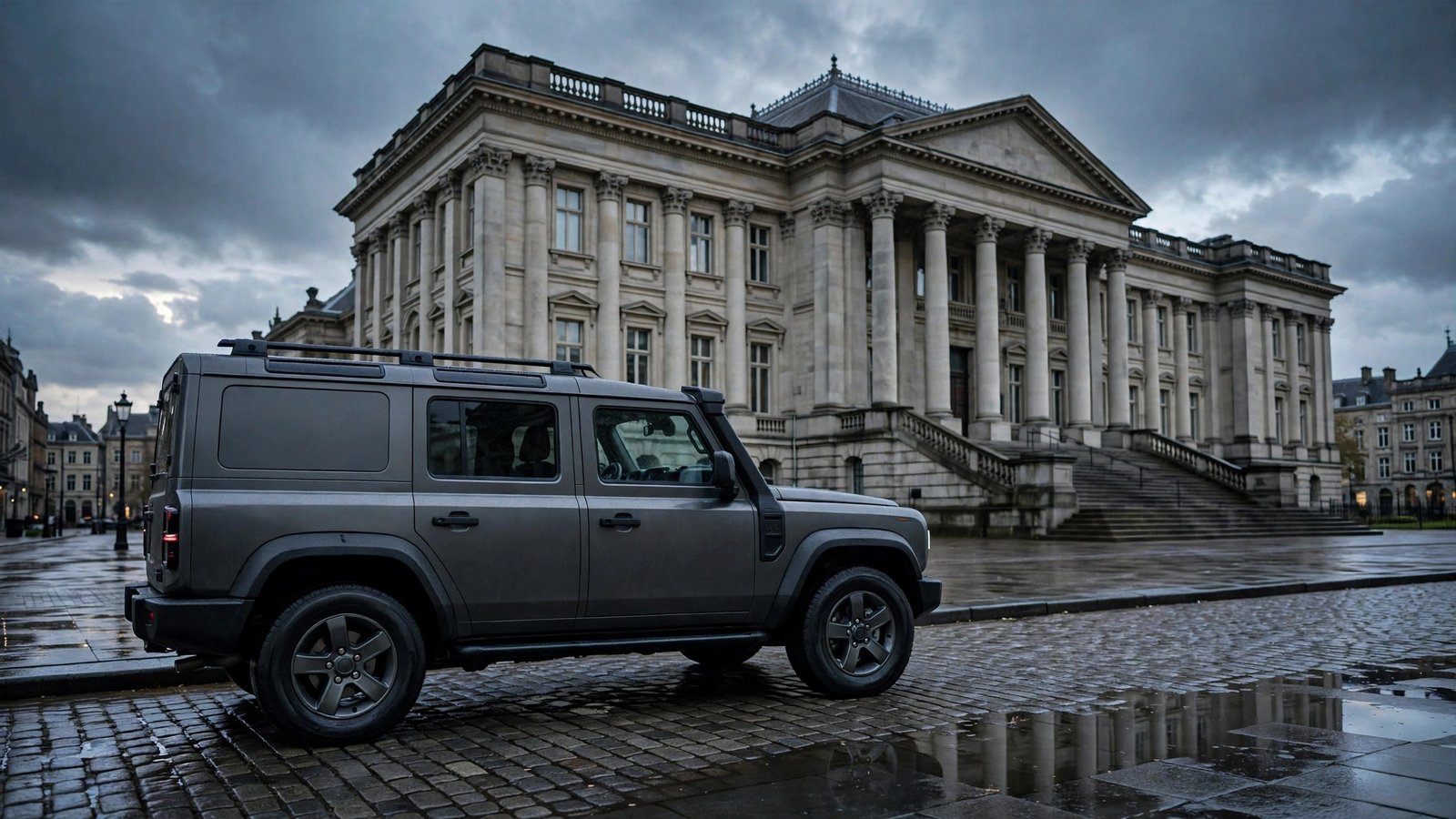
A Dutch court has banned BYD from selling one of its SUVs anywhere in the European Union, ruling that the car copies the design of the Land Rover Defender. It is the first time a European court has blocked a Chinese carmaker’s model over design rights — and the ruling also freezes production at BYD’s brand-new factory in Hungary.
The injunction, issued by the District Court of The Hague on Friday, November 20, 2026, covers the BYD Ti7, a seven-seat plug-in hybrid SUV sold under BYD’s premium Fangchengbao brand. BYD says it strongly disagrees with the ruling and will appeal. For now, though, the Ti7 cannot be sold, imported, made or even stored anywhere in the EU — while in the UK, where the same car is already on sale, nothing changes at all.
That split — banned across the EU, still selling in Britain — is what makes this case so unusual, and it is why every other Chinese carmaker planning a European launch will be watching what happens next.
What the Dutch court actually ruled
Jaguar Land Rover, the Tata Motors-owned maker of the Defender, brought the case earlier this year after BYD listed the Ti7 for orders on its UK website, with customer deliveries due to start in January 2027. JLR argued that the Ti7 infringes its registered EU design for the Defender.
The judge agreed — and did so at a remarkably early stage. The ruling came in summary proceedings, a fast-track preliminary procedure, before the full case has even been heard. Reuters noted that it is rare in Europe for major carmakers to go to court over design rights at all, and rarer still for a ruling to arrive this early in proceedings that are likely to last some time.
“In these summary proceedings, the preliminary relief judge rules that the Ti7 infringes the EU design of Jaguar Land Rover. The characteristic and distinctive elements of the design are reflected in the BYD Ti7.”
JLR welcomed the outcome in measured terms. “We protect our intellectual property and take legal action when necessary,” the company said in a statement. “Legal proceedings are ongoing, and we won’t be commenting further at this time.”
The design details the court pointed to
The Ti7 has drawn comparisons with the Defender since the day its shape was revealed. The Fangchengbao Ti7 went on sale in China in September 2025 as a rugged, boxy plug-in hybrid SUV, and motoring media immediately noted the resemblance. Top Gear magazine called it the “Chinese Defender clone”.
According to automotive media cited in the court coverage, the similarities the judge focused on include a boxy, flat-roof silhouette, upright proportions, tailgate styling, squared-off wheel arches and a solid body-coloured panel behind the rear passenger door — the distinctive C-pillar treatment that is one of the Defender’s signature design cues.
BYD disputed all of it. The company argued that the Ti7 has its own design identity and pointed to differences in the headlights, grille, bonnet, bumpers and other exterior elements, saying those differences were enough to set it apart. The court disagreed, finding that the differences did not sufficiently change the overall visual impression of the car.
The Defender is not a minor model for JLR to defend. It is the company’s most popular vehicle, with global sales of more than 100,000 units in 2025. JLR’s registered EU design for the Defender dates back to April 2018, giving it a well-established claim to the look.
What the ban covers — and the UK exception
The preliminary injunction bars BYD from manufacturing, importing, offering, selling, storing or distributing the Ti7 anywhere in the European Union until the intellectual property case is resolved.
There is one important limit on the ruling. The judge found that the Dutch court has no jurisdiction over BYD’s affiliate in the United Kingdom, so the ban does not apply there. That matters because the UK is the one European market where the Ti7 is already being sold: it went on sale in Britain at £47,995, more than £20,000 cheaper than a Defender, with the first customer deliveries due from January 2027. Those UK orders and deliveries are unaffected by the Hague ruling.
The ban itself does not take effect immediately. It comes into force one week after the ruling — on November 27, 2026 — because, as the court noted, BYD “currently has no concrete plans to place the Ti7 on the market in the EU”. In other words, there is nothing to stop right now inside the EU, so the court gave the injunction a one-week delay. No Ti7 already sold in the EU needs to be recalled, because none has been sold there yet.
The Hungary factory is caught in the ban too
The ruling goes further than sales. Until the case is resolved, the court also banned BYD from producing the Ti7 at its new factory in Szeged, Hungary, which is due to start mass-producing cars early next year.
That is a significant blow to BYD’s European plans. The Hungarian plant is central to the company’s strategy of building cars inside the EU rather than importing them from China, and the Ti7 was expected to be part of that production. The factory itself is not shut down — the ban covers the Ti7 specifically — but it cannot build that model until the dispute is settled.
The timing is awkward for BYD. The company has grown fast in Europe since launching sales on the continent in late 2022. According to ACEA data cited by Reuters, BYD’s European sales more than doubled to over 280,000 vehicles in 2026 through September, outselling Ford, Tesla and Nissan. Globally, BYD sold more than 1.51 million vehicles outside China in the first ten months of 2026, up 93.8 percent on the year, according to its own sales data reported by the South China Morning Post.
The twist: JLR was also told to destroy documents
The case has not gone entirely JLR’s way. In August 2026, court-ordered bailiffs raided BYD’s offices in the Netherlands to seize paper and digital documents about the design of the Ti7, after JLR took BYD to court over the copycat claims. JLR alleged that BYD could have infringed its intellectual property rights by reverse-engineering the Defender.
But on November 12 — just eight days before the injunction — the same District Court of The Hague ordered JLR to destroy the documents obtained in the raids on BYD’s offices in Schiedam and Hoofddorp. The court found the seized material was unnecessary for the design infringement proceedings and that there were insufficient grounds for obtaining financial information about BYD’s EU sales.
So both sides now carry a court order from the same dispute: BYD is barred from selling and building the Ti7 in the EU, and JLR must destroy the evidence it collected in the raids. Neither side has the clean win it wanted, and the full case is still to be heard.
What BYD says — and what happens next
BYD’s response was immediate and uncompromising. “BYD strongly disagrees with the judgment and will appeal it,” the company said in a statement. “The BYD Ti7 is the result of BYD’s own independent design work and infringes none of JLR’s rights. We will pursue every legal avenue to demonstrate that this decision is incorrect.”
Investors reacted quickly. BYD’s shares fell after the ruling, according to the Wall Street Journal, as the market weighed what a design ban could mean for the company’s European expansion.
What happens next depends on the appeal. BYD will challenge the preliminary injunction, and the full intellectual property case will continue in The Hague — a process Reuters expects to last for some time. If BYD wins on appeal or at trial, the ban lifts and the Ti7 can be sold and built in the EU. If JLR’s claim is upheld, BYD would need to redesign the Ti7’s distinctive elements or abandon the model in Europe altogether.
Either way, the case sets a precedent that other Chinese carmakers cannot ignore. “The legal dispute between BYD and JLR will be closely monitored by other Chinese automotive groups, as all of them aim to launch more new models abroad to increase their overseas sales,” said Chen Jinzhu, CEO of Shanghai Mingliang Auto Service, speaking to the South China Morning Post. “Chinese carmakers need to pay more attention to legal risks as they expand abroad.”
That warning lands at a moment when Chinese brands are scaling up fast. JPMorgan’s head of Asia-Pacific auto research, Nick Lai, forecast in May that Chinese carmakers led by BYD would deliver 2.5 million cars to customers in western European countries including Germany, Italy, France and the UK in 2028 — a surge of 150 percent from about 1 million units last year.
Why this ruling matters far beyond one SUV
Design-copy disputes are not new in the car industry, but they almost never reach a courtroom in Europe. Legacy carmakers have often complained that Chinese rivals copy their designs, yet little has been proven in court. The best-known earlier example comes from 2005, when General Motors and China’s Chery settled a case over the Chery QQ, which GM said was a copy of its Chevrolet Spark.
The Ti7 ruling breaks that pattern. It is the first time a European court has sided with a legacy carmaker against a Chinese rival on design grounds, and it did so before the full trial — a signal to every Chinese brand that European design registrations carry real force.
The stakes go beyond BYD. Chinese carmakers are moving into Europe with boxy, rugged SUVs that deliberately echo the look of established off-road icons, because that look sells. If courts are willing to block those models, the cost of copying a popular design rises sharply — and brands will have to spend more on original styling or accept the legal risk.
For JLR, the ruling protects its most valuable asset at a moment when the Defender is its best-selling model. For BYD, the immediate damage is limited — the Ti7 was not yet selling in the EU — but the message is clear: its European growth now depends not just on price and technology, but on surviving legal scrutiny of its designs.
What it means if you wanted a Ti7
If you are in the UK, nothing changes. The Ti7 is on sale at £47,995, with deliveries due from January 2027, and the Dutch court’s ruling does not touch BYD’s UK business. Your order stands.
If you are in the EU, the Ti7 is effectively off the table for now. BYD has no concrete plans to sell it in the EU, the ban takes effect on November 27, and no EU price or launch date has been announced. The earliest realistic route back would be a successful appeal — and even then, BYD would need to restart its EU launch plans from scratch.
The broader lesson for buyers is simpler: the Ti7’s fate is now a legal question, not a product question. The car itself has not been recalled, judged unsafe or found faulty in any way. The dispute is purely about how it looks — and whether that look belongs to someone else.
Frequently Asked Questions
Is the BYD Ti7 banned in Europe?
Yes, in the European Union. A Dutch court issued a preliminary injunction on November 20, 2026, barring BYD from selling, importing, manufacturing or distributing the Ti7 in the EU. The ban takes effect on November 27, 2026. It does not apply in the UK, where the Ti7 remains on sale.
Why was the BYD Ti7 banned?
The District Court of The Hague ruled that the Ti7 infringes Jaguar Land Rover’s registered EU design for the Land Rover Defender. The court found that the Defender’s characteristic design elements — its boxy, flat-roof silhouette, upright proportions, tailgate styling, squared-off wheel arches and the solid body-coloured panel behind the rear passenger door — are reflected in the Ti7.
Can I still buy a BYD Ti7 in the UK?
Yes. The Dutch court ruled it has no jurisdiction over BYD’s UK affiliate, so the ban does not cover Britain. The Ti7 is on sale in the UK from £47,995, with customer deliveries due from January 2027.
What is the BYD Ti7?
The Ti7 is a seven-seat plug-in hybrid SUV sold under BYD’s premium Fangchengbao (Fang Cheng Bao) brand. It went on sale in China in September 2025. BYD launched the Fangchengbao brand in 2023 as a rival to off-road names such as Toyota’s Prado and Land Rover.
Will BYD appeal the Ti7 ban?
Yes. BYD said it “strongly disagrees” with the judgment and will appeal, adding that it will “pursue every legal avenue to demonstrate that this decision is incorrect”. The full intellectual property case in The Hague is still ongoing, so the ban could be lifted if BYD wins on appeal or at trial.
Sources: Reuters, “Dutch court bars Chinese SUV in Europe over resemblance to Land Rover Defender” (Nov 20, 2026); South China Morning Post, “BYD pledges to fight EU sales ban in infringement battle with Jaguar Land Rover” (Nov 23, 2026); Wall Street Journal, “BYD’s Shares Fall After Dutch Court Bars Sales of Ti7 SUV Model in EU” (Nov 20, 2026); ExecReview, “Court bans China’s BYD from selling ‘Defender clone’ SUV in EU” (Nov 22, 2026).
