


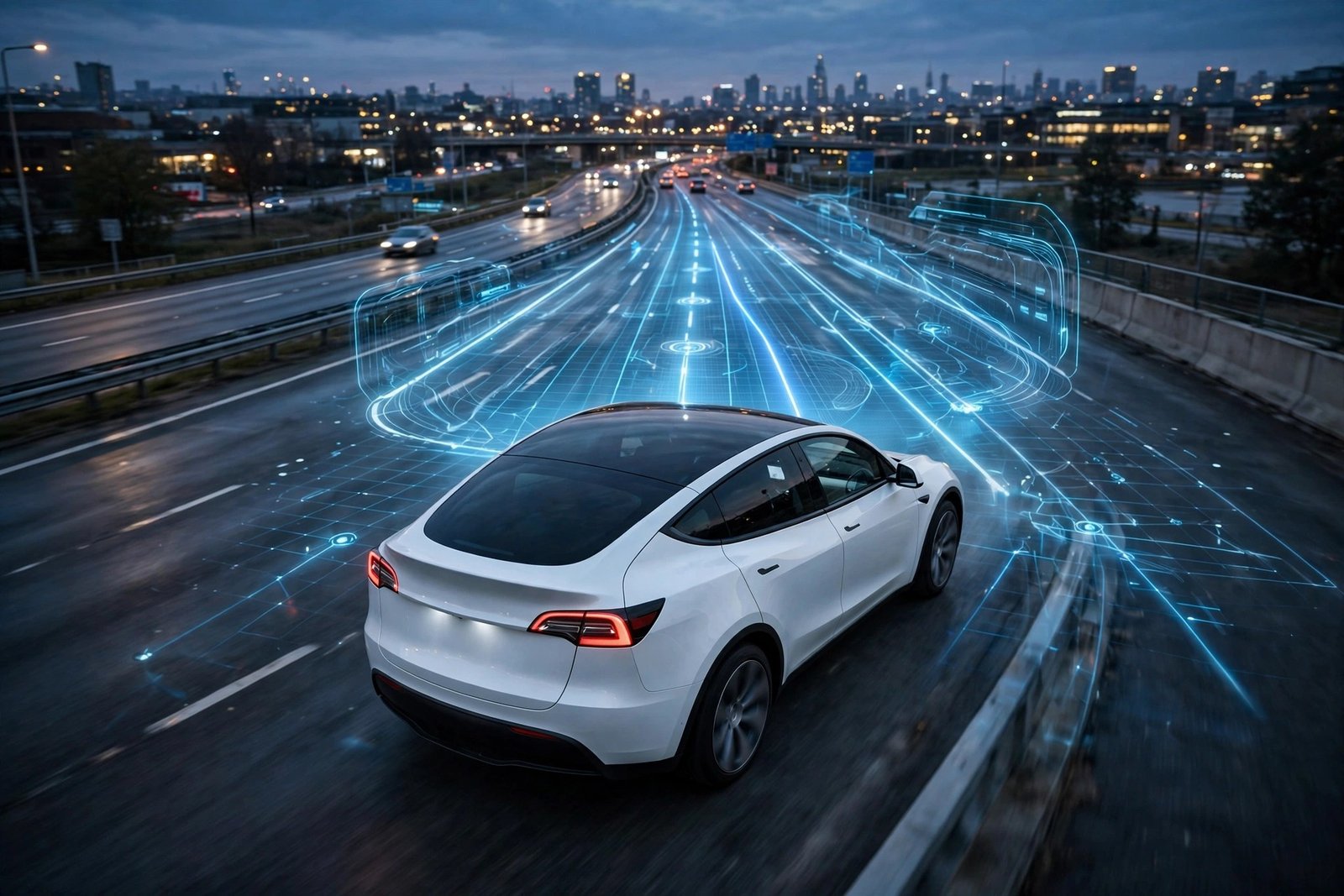
Tesla’s biggest self-driving update of the year is no longer limited to its newest cars. Full Self-Driving (Supervised) v15, which started rolling out to a first wave of owners on Saturday, November 21, 2026, is now reaching older Model Y cars too — and fleet trackers show the rollout gathering speed ahead of the wide release Tesla has promised for December.
The widening matters because the first cars to get v15 were all refreshed 2026 Model Ys with Hardware 4. On November 24, an owner of an older-design Model Y posted screenshots of the car downloading the same v15 build, and tracker data logged on November 25 shows six pre-refresh Model Ys from the 2023 and 2024 model years now running the update. All 27 cars logged so far are Model Ys in the United States — no Model 3, Model S, Model X or Cybertruck has received it yet, and no car in Europe has either.
What happened
Tesla announced the rollout on X on November 21 at 19:24 UTC with a short post: “FSD v15 now starting to roll out.” The company’s AI lead, Ashok Elluswamy, wrote minutes later that the version was “releasing to the first wave of customers today.” About twelve hours earlier, chief executive Elon Musk had said the version would go to wide release in December, arriving as part of Tesla’s annual Holiday Update.
The first build is FSD (Supervised) v15.0.1, delivered through software update 2026.38.6.11, according to the tracker site Not a Tesla App. Tesla itself gave no build number, no list of eligible cars and no hardware requirement in its announcement — the details have come from owners, trackers and Tesla’s own release notes posted by its Tesla Super Intelligence account on X half an hour after the announcement.
The first two cars on v15 were logged by the TeslaFi tracker between 00:23 and 01:41 UTC on November 22: a refreshed Model Y Long Range in Florida and a Model Y Long Range RWD in Texas. Both have Hardware 4, Tesla’s AI4 computer, and both moved up from firmware 2026.38.5.13, which carries FSD v14.3.13. By 02:10 UTC on November 25, TeslaFi had logged 27 cars on the build, 20 of them on November 24 alone. Six are pre-refresh Model Ys — three Long Range, two Performance and one Standard Range. The other 21 are refreshed 2026 cars.
The first older-car sighting came on November 24, when an owner of a pre-refresh Model Y with Hardware 4 posted screenshots of the car downloading firmware 2026.38.6.11, as reported by TeslaNorth. The older design lacks the front bumper camera of the redesigned Model Y, which suggests the new vision system does not depend on that extra camera.
What is new in FSD v15
Tesla’s release notes say v15 “upgrades every part of the end-to-end driving network” — the single AI model that takes in camera video and outputs steering, braking and acceleration. The changes fall into five groups.
A new vision encoder — and a 25x claim Tesla has not backed up
At the heart of v15 is an upgraded vision encoder, the part of the network that turns camera footage into an understanding of the road. Tesla says the encoder is shared between FSD, its Robotaxi service and the Optimus humanoid robot, and that it was trained on “millions of internet videos for improved generalization and data efficiency, improving the critical intervention rate by 25x.”
That 25x figure is the headline number Tesla is leading with, and it cannot be checked. Tesla has published no critical intervention rate for v14 or v15 — only the multiplier. Elluswamy restated the claim on November 22 as “v15 is 25x safer than v14 across the fleet,” adding that the difference “only becomes clear when you aggregate millions of miles.” He gave no mileage, no intervention count and no baseline. Until Tesla publishes fleet data, the 25x figure is a claim, not a measurement.
Tesla Reality View
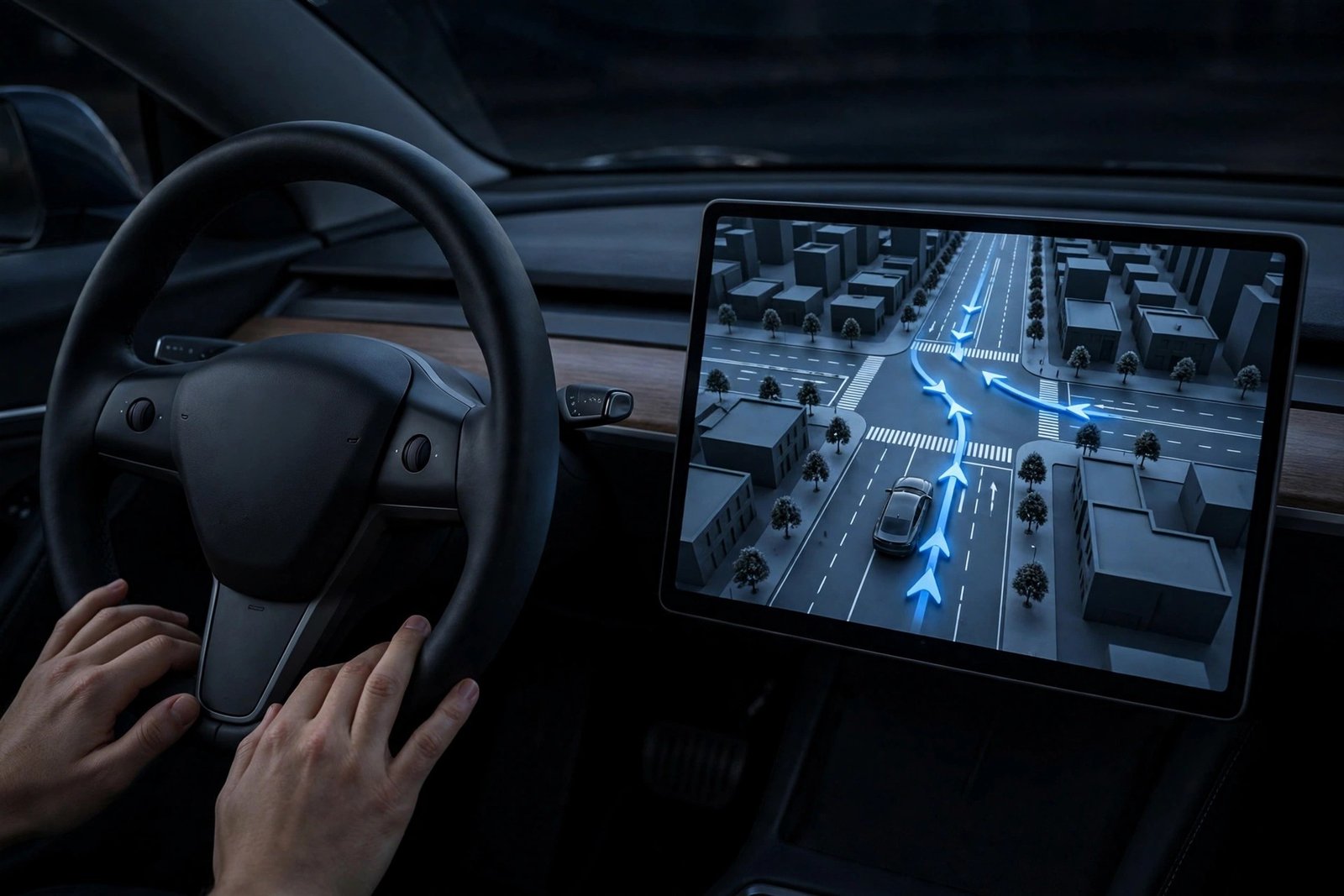
The most visible change for drivers is Tesla Reality View, a new driving display that replaces the old simplified on-screen graphics with a detailed, live rendering of the street around the car. Tesla describes it as a real-time generative visualization that “continuously streams a view from an arbitrary virtual camera situated above your vehicle,” showing what FSD plans to do — arrows mark the turns it intends to take, and pins mark the parking spot it aims for. Drivers can choose a full-screen view, a map, a split screen or a quiet mode, and upcoming turns appear directly in the visualization.
Musk has described Reality View as real-time AI video generation with no gaming engine, running on “just half of one AI4 TRIP accelerator.” Elluswamy called it “pixels-in-pixels-out”: camera images go in, and the rendered view comes straight out of the driving model, so the display shows the car’s intent rather than a game-style reconstruction. Teslarati’s first-hand review of v15.0.1, published after the reviewer received the update on the first night, called the view “absolutely insane” and said it was hard to believe at first glance that a drone was not following the car.
There is a catch the reviewer noticed immediately: some input lag. Musk has already addressed it, saying the latency is “a bit high due to compute constraints” and that Tesla has ways to cut roughly 35 percent of it by interleaving newer features along the model’s layers. Tesla also says drivers can “tap any point” in Reality View to make the car go there, and its demonstration video shows a driver doing exactly that at a city intersection — but the release notes do not explain how the tap control works or where it is limited, and everything shown so far comes from Tesla’s own demonstrations. Everyday reliability still needs independent testing.
Learned navigation and parking
Routes at the start and end of a trip now come from a model trained on fleet route preferences, so FSD should learn the way a driver actually begins and ends a journey — for example, which driveway exit or car park entrance they prefer. Tesla says later v15 releases will extend that learned navigation to the whole route. Parking spots are now chosen from the owner’s own parking history, with several options shown on the map.
Better detection of the things FSD gets wrong
The release notes promise better recognition of road signs, small animals, debris, chains and potholes, and avoidance of deep standing water. Speed handling has been reworked for each driver profile, school zones, speed limits and bad weather. These are pointed at documented weak spots: in Brussels, a test by the charity Johanna.be found FSD over the limit in 55 percent of the 30 km/h segments it drove, and in the US the safety regulator NHTSA is reviewing claims that Tesla’s robotaxis speed through school zones. Pothole avoidance has been promised since 2019; the notes promise better detection of potholes, not that the car will steer around them.
Two smaller features round out the list. Speed Camera Slowdown lets FSD slow down for a speed camera it detects — pressing the accelerator cancels it, and after two cancellations at the same camera the car stops slowing there. Bike Rack Mode allows supervised FSD with a bike rack or a similar hitch accessory: with the mode on, FSD pulls over near the destination instead of reversing, and Autopark, Summon and the reversing chimes are switched off. Driver monitoring has also been loosened in places: the cabin camera checks now work more often when the driver wears a hat or sunglasses, and they are less strict in the higher-speed driver profiles.
One quiet removal
FSD v15 also removes the feedback menu that has appeared every time a driver takes over from FSD since v14.3.2 in the spring. On the new build, no prompt or dialog appears when FSD is disengaged — until now, the driver had to pick a reason for the takeover or record a voice note before the menu closed, and it had no button to dismiss it. Tesla’s release notes do not mention the change, and the company has not said why it made it. Drivers can still report a problem with a voice note.
Which cars get it — and which do not
Tesla has described v15 as a rewrite built for the AI4 computer, also known as Hardware 4. So far the tracker evidence matches that: every car logged on v15 is a Model Y with Hardware 4 in the United States. Hardware 3 cars stay on the separate v14 Lite branch, and Tesla has not said whether they will ever get v15.
Cars in Europe are not getting v15 yet either. There the system is called Tesla Assisted Driving and is approved in 12 EU countries through the Dutch authority RDW. Those cars run firmware 2026.39.100, which shows FSD v14.2.2.7, and every change so far has needed the RDW’s approval first. The RDW has published nothing about v15, and its newest Tesla notice is the November 16 update.
In the US, FSD is now sold only as a subscription, at 99 dollars a month. The system remains FSD (Supervised): it steers, brakes and navigates, but a human must watch the road at all times and be ready to take over.
What happens next
The next milestone is the wide release Musk promised for December, arriving with Tesla’s 2026 Holiday Update. That is when most eligible owners should expect the update — the current rollout is a first wave, and Tesla has not published a schedule for which models or regions follow. The open questions are whether Model 3, Model S, Model X and Cybertruck join the rollout before December, whether any Hardware 3 car gets a version of v15, and when European cars get past the RDW approval step.
The bigger question is the 25x safety claim. Tesla’s own AI director, Phil Duan, has said the difference is apparent across millions of fleet miles, not on a single drive — which is exactly why independent data matters. Fleet trackers, safety regulators and reviewers will be watching whether the critical intervention rate actually improves as more cars get the update, and whether Reality View’s lag and tap-to-direct control hold up outside Tesla’s demonstrations.
For now, the rollout is real, it is widening, and it is moving faster than the first night suggested: from two cars on November 22 to 27 by the morning of November 25, with older Model Ys now in the mix. Owners with a Hardware 4 car and an FSD subscription can check by going to Controls, then Software, and looking for firmware 2026.38.6.11.
Frequently Asked Questions
What is Tesla FSD v15?
FSD (Supervised) v15 is Tesla’s newest Full Self-Driving software, first released as version 15.0.1 in firmware update 2026.38.6.11. Tesla says it upgrades every part of the end-to-end driving network, with a new vision encoder, a generative driving display called Tesla Reality View, learned navigation, better detection of signs, animals, debris and potholes, Speed Camera Slowdown and Bike Rack Mode.
When did Tesla start rolling out FSD v15?
Tesla announced the rollout on X on Saturday, November 21, 2026, at 19:24 UTC, and its AI lead Ashok Elluswamy confirmed it was “releasing to the first wave of customers today.” The first cars were logged by the TeslaFi tracker in the early hours of November 22. Elon Musk has said a wide release will follow in December with the 2026 Holiday Update.
Which Tesla cars are getting FSD v15?
So far only Model Y cars with the Hardware 4 (AI4) computer in the United States have been logged on the build — 27 cars by the morning of November 25, including six pre-refresh 2023 and 2024 Model Ys. No Model 3, Model S, Model X or Cybertruck has been logged yet, and no car in Europe has received it. Hardware 3 cars stay on the separate v14 Lite branch.
What is Tesla Reality View?
Reality View is v15’s new driving display: a real-time, AI-generated view of the road from a virtual camera above the car, showing what FSD plans to do, with arrows for upcoming turns and pins for parking spots. Drivers can pick a full-screen view, a map, a split screen or a quiet mode. Tesla says it uses less computing power than the old visualization, but early reviewers note some input lag.
Is Tesla’s 25x safety claim proven?
No. Tesla says the new vision encoder improves the critical intervention rate by 25x, but it has published no baseline intervention rate for v14 or v15, no mileage and no intervention counts. The figure is Tesla’s claim, and it can only be verified once fleet-level data is published or independently measured.
How much does FSD cost, and is it still supervised?
In the US, FSD is now sold only as a subscription at 99 dollars a month. FSD (Supervised) v15 is still a driver-assistance system: it steers, brakes and navigates, but the driver must stay attentive and ready to take over at any moment.
Related Articles
- Waymo Recalls Nearly 4,500 Robotaxis After 11 Drove Into Closed Freeway Lanes
- BMW Neue Klasse iX3 and i3 Launch in China on November 25 and 27
- BYD Tang EV Launched: 850 km Range From $28,000
Sources: Teslant, “Tesla Starts Rolling Out FSD v15: Reality View, Speed Camera Slowdown and a 25x Claim” (updated November 25, 2026); Electrek, “Tesla launches FSD v15, targets its biggest weaknesses, from signs to potholes” (November 21, 2026); TeslaNorth, “Tesla Software Update 2026.38.6.11: FSD v15.0.1 Release Notes” (November 21, 2026); Teslarati, “Tesla Full Self-Driving v15: Reality View review, new features explained” (November 22, 2026).
