


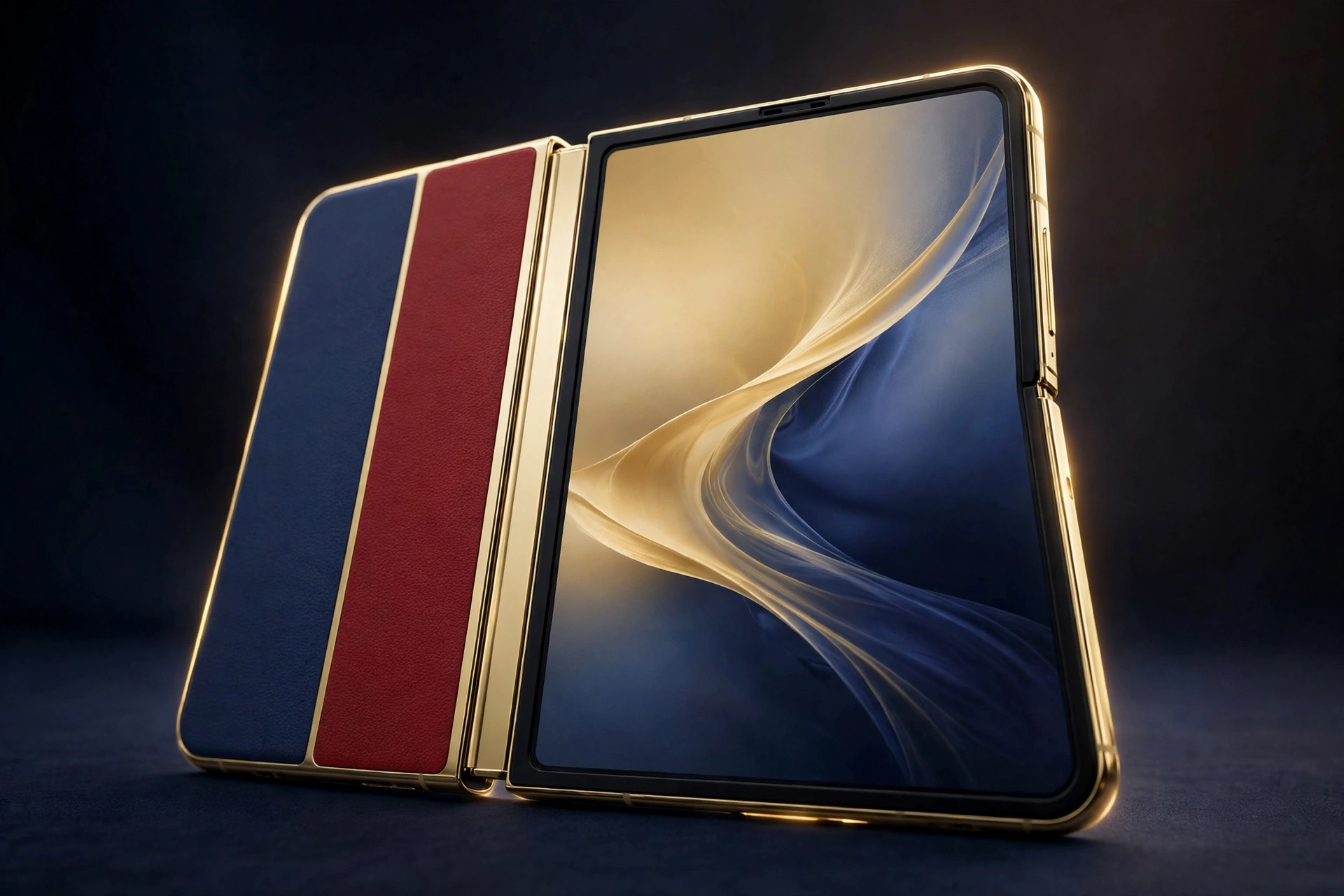
Samsung has put its most expensive foldable of the year on sale — and almost nobody reading this can buy one. The Samsung W27, a gold-finished luxury version of the Galaxy Z Fold8 Ultra, went on sale in China on November 13, priced from CNY 18,999 (roughly $2,850) for the 16GB RAM and 512GB storage model. The top 16GB and 1TB version costs CNY 21,999, or about $3,300.
The W27 is part of Samsung’s long-running W series, a line of China-exclusive luxury phones built in partnership with China Telecom and sold under the “Heart of the World” banner. Every year, Samsung takes its flagship foldable, dresses it in a more premium finish, adds a few business-focused extras, and sells it only in China. The W27 follows that tradition exactly — which is why the phone matters even if you will never hold one: it shows how far Samsung is willing to push foldable pricing, and how much of that price is design and positioning rather than hardware.
Under the gold trim, the W27 is the Galaxy Z Fold8 Ultra. The two phones share the same displays, the same chip, the same cameras and the same battery. What changes is the finish, the colours, the storage tiers, and one feature the standard Fold8 Ultra does not have: satellite connectivity through China’s Tiantong network.
Samsung W27 Price and Availability
The Samsung W27 is available in two configurations, both with 16GB of RAM:
- 16GB RAM + 512GB storage: CNY 18,999 (about $2,850)
- 16GB RAM + 1TB storage: CNY 21,999 (about $3,300)
Reservations opened on October 29, when Samsung unveiled the phone at its “Heart of the World” event, and official sales began on November 13 through Samsung’s online store in China and China Telecom channels. Buyers who registered early were offered a Samsung Care+ package valued at CNY 1,399, covering discounted screen and battery replacement.
There is no lower-priced version. Samsung skipped the 256GB tier entirely, so the cheapest W27 still costs more than most flagship phones — and more than the standard Galaxy Z Fold8 Ultra, which starts at $1,899.99 in the US for the 256GB model.
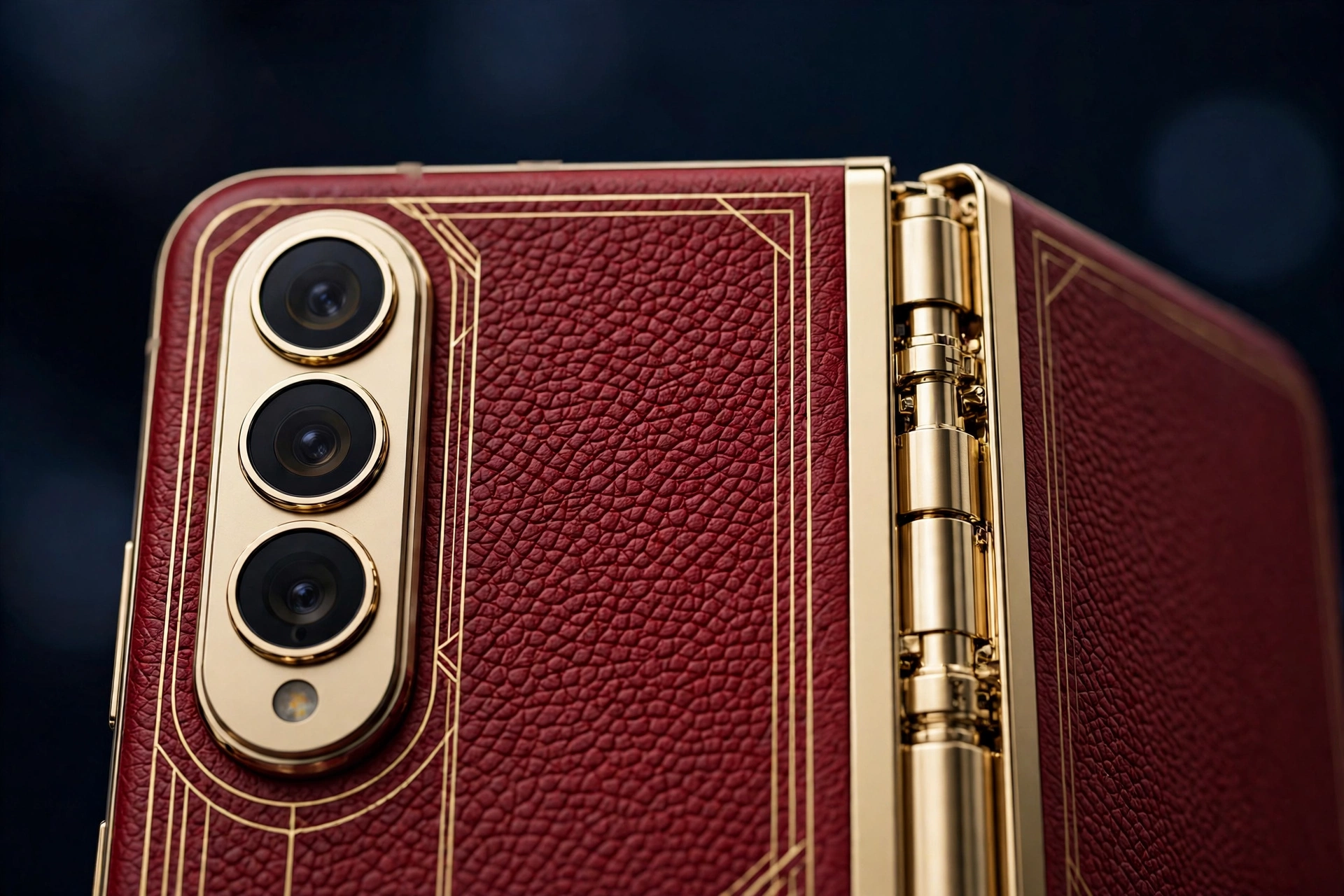
A Gold Finish on the Galaxy Z Fold8 Ultra
The visible difference between the W27 and the standard Fold8 Ultra is the design. The W27 has a gold-coloured frame and camera island, a textured frame finish, and a dual-tone rear in two colours inspired by traditional Chinese culture: Jihu Blue, a deep glaze blue, and Jixia Hong, a deep red. Samsung calls the look a luxury makeover, and it is aimed squarely at the business buyers and collectors who have made the W series a fixture in China.
The phone is thin and light for a book-style foldable: 8.9mm folded, 4.1mm unfolded (excluding the camera module), and 215 grams. The W27 ships in a collector-style presentation box, in keeping with the W series’ positioning as a premium gift and status device rather than a mass-market phone.
Displays: 8-Inch Inner Screen, 6.5-Inch Cover Screen
The W27 keeps the Fold8 Ultra’s display setup. The inner folding screen measures 8 inches (QXGA+ resolution, 2504 x 2256) on a Dynamic AMOLED 2X panel, and the cover screen is 6.5 inches (FHD+, 2520 x 1080). Both panels refresh adaptively from 1Hz to 120Hz, support HDR10+, and reach up to 3,000 nits of peak brightness.
The inner panel also carries an anti-reflective coating, which helps with glare when the phone is used outdoors or under bright office lighting — a practical touch for a device that is meant to be used unfolded as a small tablet for work.
Snapdragon 8 Elite Gen 5 for Galaxy
Powering the W27 is Qualcomm’s Snapdragon 8 Elite Gen 5 for Galaxy, the same custom chip in the standard Fold8 Ultra. Samsung says its internal testing shows the chip delivering 16% faster CPU performance, 15% better GPU performance and 21% more efficient NPU performance than the previous W-series model. Independent third-party benchmarks for the W27 itself have not yet been published, so those figures should be read as Samsung’s own claims rather than verified results.
The chip is paired with 16GB of RAM in both configurations, with storage of either 512GB or 1TB. There is no microSD expansion, which is standard for Samsung’s foldables.
On the software side, the W27 runs Android 17 with Samsung’s One UI 9, including the split-screen and three-window multitasking features designed for the large inner display, plus Samsung’s Galaxy AI features.
Cameras: 200MP Main, 50MP Ultrawide, 10MP Telephoto
The camera system is unchanged from the Fold8 Ultra. It is led by a 200-megapixel main sensor with optical image stabilisation and an f/1.7 aperture, alongside a 50-megapixel ultrawide camera and a 10-megapixel telephoto camera with 3x optical zoom and 30x Space Zoom. There are two 10-megapixel selfie cameras, one on the cover screen and one on the inner screen. The main and ultrawide cameras can record video at up to 8K at 30 frames per second, while all cameras support 4K at 60 frames per second.
Samsung’s own comparison with the older W24 underlines how far the camera hardware has moved: the W24 had a 50MP main camera, while the W27 jumps to 200MP.
Battery, Charging and the One Real Hardware Difference
The W27 packs a 5,000mAh battery — up from 4,400mAh in last year’s W26 — with 45W wired charging and 20W wireless charging (Qi2.2). Samsung rates the battery for up to 27 hours of video playback under its own test conditions.
The single hardware addition over the standard Fold8 Ultra is satellite connectivity through China’s Tiantong satellite network. The W27 supports Tiantong satellite voice calls and messaging when ground networks are unavailable, and the launch offer includes a year of satellite service with 300 minutes of satellite voice calls and 100 satellite texts, according to launch coverage. The feature requires an eligible satellite service plan from a supporting Chinese operator.
Beyond that, the W27 carries an IP48 rating for dust and water resistance, a side-mounted fingerprint sensor, Wi-Fi 7, Bluetooth 6.0 and NFC.
Samsung W27 vs Galaxy Z Fold8 Ultra: What’s Actually Different?
For most buyers, the honest answer is: very little, beyond the price and the finish. The W27 is, in effect, a Fold8 Ultra with a luxury outfit, a higher memory floor, and satellite calling. Whether that is worth roughly $950 more than the base Fold8 Ultra depends entirely on whether the buyer values the design, the China Telecom partnership extras, and the exclusivity — because the phone in the hand will feel identical.
Why the W27 Matters Even If You Can’t Buy It
The W27 is easy to dismiss as a curiosity, but it tells us two useful things about Samsung’s foldable strategy. First, Samsung clearly believes there is a market for foldables well above $2,500 — it is testing how high the ceiling goes, at least in its most premium market. Second, the W series continues to be Samsung’s quiet laboratory for features that may or may not reach global phones: Tiantong satellite support is China-specific, but shipping satellite calling on a foldable is a signal worth watching as satellite messaging becomes more common across flagship phones.
Samsung W27 vs W26: What Changed in a Year
The W27 is not just a new coat of paint on last year’s luxury foldable — the generational jump is real. The W26 launched at CNY 16,999 for its 512GB model, while the W27 starts CNY 2,000 higher at CNY 18,999. For that extra money, buyers get a phone that is lighter, thinner, brighter and considerably more powerful.
Weight drops from 270 grams on the W26 to 215 grams, folded thickness falls from 13.4mm to 8.9mm, and peak display brightness jumps from 1,750 nits to 3,000 nits. The main camera moves from 50MP to 200MP, and battery capacity grows from 4,400mAh to 5,000mAh. The chip upgrade is the biggest single change: Samsung’s internal figures claim 16% faster CPU performance, 15% better GPU performance and 21% more efficient NPU performance than the W26 — numbers that, if they hold up in independent testing, would make the W27 noticeably faster at AI tasks, gaming and photo processing.
One thing that has not changed is the formula itself. The W series has always been a China Telecom partnership product, and the W27 keeps that relationship, including the Tiantong satellite service bundle and the “Heart of the World” branding. The luxury positioning, the collector’s box and the limited colour choices are all part of a playbook Samsung has refined over many years — and the W27’s price rise suggests the company believes that playbook still has room to grow.
The Bigger Picture: Foldables Are Getting Expensive at the Top
The W27 arrives at a moment when foldable pricing is splitting in two directions. On one side, brands are pushing cheaper foldables toward the mainstream. On the other, the top of the market keeps climbing: the W27 at roughly $2,850 sits above Apple’s iPhone Duo foldable, which reports price at around $2,401 for the 256GB model.
That split is not an accident. Foldables are becoming a range that runs from affordable flip phones to ultra-premium book-style devices that double as status symbols, and the W27 belongs firmly in the second group. It is not trying to win on value. The phone is a statement — about what Samsung can build, about the W series’ place in Chinese business culture, and about how much headroom remains at the top of the foldable market.
For the rest of the world, the practical takeaway is simpler. The hardware underneath the gold finish is the same hardware in the Galaxy Z Fold8 Ultra, a phone anyone can buy globally for considerably less. The W27 is what happens when that hardware is dressed for a very specific audience and priced accordingly.
Should You Wait for a Global Version?
No. Samsung has never brought a W-series phone outside China, and it has announced no plans to do so with the W27. If you want the same hardware, the Galaxy Z Fold8 Ultra is the phone to buy — it is available globally, starts at a much lower price, and differs from the W27 only in finish, storage tiers and satellite support.
The W27 is a China-only statement piece: a beautifully finished, very expensive foldable for a market that treats phones as status objects. For everyone else, it is a preview of how good — and how expensive — Samsung’s foldables have become.
FAQs
Q1: What is the Samsung W27 price?
The Samsung W27 starts at CNY 18,999 (about $2,850) for the 16GB RAM and 512GB storage model. The 16GB and 1TB version costs CNY 21,999 (about $3,300). Both prices are for China only.
Q2: Is the Samsung W27 available outside China?
No. The Samsung W27 is a China-exclusive phone sold through Samsung’s China store and China Telecom. Samsung has announced no international launch, and the W series has never been sold outside China.
Q3: Is the Samsung W27 the same as the Galaxy Z Fold8 Ultra?
Almost. The W27 is a luxury version of the Galaxy Z Fold8 Ultra with the same displays, Snapdragon 8 Elite Gen 5 for Galaxy chip, 200MP camera system and 5,000mAh battery. The differences are the gold finish, the two exclusive colours, 16GB of RAM as standard, and Tiantong satellite calling.
Q4: When did the Samsung W27 go on sale?
The Samsung W27 was unveiled on October 29, 2026, and went on sale in China on November 13, 2026. Reservations opened on October 29 through Samsung’s online store in China.
Q5: Does the Samsung W27 support satellite calling?
Yes. The W27 supports Tiantong satellite voice calls and messaging in China when ground networks are unavailable. It requires an eligible satellite service plan from a supporting Chinese operator, and the launch offer includes a year of service with 300 minutes of satellite calls and 100 satellite texts.
Sources: GSMArena, “The Samsung W27 goes official in China”, October 29, 2026; Android Authority, “Samsung’s next foldable is here, and it’s even more expensive than the iPhone Duo”, October 30, 2026; Gadgets 360, November 14, 2026 (sale coverage).
