


Summary
- OnePlus launched the OnePlus 15 globally on 13 November 2026, seventeen days after its China debut on 27 October. It is the company’s new flagship, and the battery is the headline.
- The phone packs a 7,300mAh silicon-carbon battery — the largest OnePlus has ever put in a flagship — with 120W wired charging and 50W wireless charging.
- Prices start at $899.99 for 12GB of RAM and 256GB of storage, and $999.99 for 16GB and 512GB. In India the phone is listed at Rs. 85,999.
- A 6.78-inch LTPO AMOLED display runs at up to 165Hz in games, and Qualcomm’s Snapdragon 8 Elite Gen 5 chip powers the phone, paired with LPDDR5X RAM and UFS 4.1 storage.
- There is one catch for American buyers: the US launch is delayed because of the government shutdown, with sales waiting on certification. Everywhere else, the phone is on sale now.

The Global Launch, Seventeen Days After China
OnePlus did not wait long. The OnePlus 15 first appeared in China on 27 October, and on 13 November the company took it global. The launch covers Europe, India, Canada and other international markets, with the phone going on sale the same week in most of them. It is one of the fastest international rollouts OnePlus has ever managed — seventeen days from the China launch to a global one.
The timing puts the phone in shops well ahead of the holiday season, and it lands in a crowded field. Xiaomi is about to launch its 18 Pro globally on 17 November, and the big flagships from Samsung, Google and Apple are already on shelves. OnePlus is betting that a huge battery and an aggressive price will be enough to stand out.
The global model is the same phone that launched in China, with one software difference: it runs OxygenOS 16, based on Android 16, while the Chinese model runs ColorOS 16. OnePlus promises four years of operating system updates and six years of security updates, which is now the standard it needs to match rather than a selling point on its own.
The Battery Is the Story
The number that leads every spec sheet is 7,300mAh. That is the size of the silicon-carbon battery inside the OnePlus 15, and it is a large jump from the 6,000mAh unit in last year’s OnePlus 13. Silicon-carbon batteries store more energy in the same space than the older lithium-ion cells, which is how OnePlus fit a bigger battery into a phone that is barely thicker than its predecessor.
The battery is a dual-cell design, and it charges fast. Wired charging runs at 120W in most markets, up from 100W on the OnePlus 13, and wireless charging stays at 50W. In the United States and Canada, wired charging is limited to 80W, which is a regional restriction OnePlus has applied before. A charger is included in the box in at least some regions, though that varies by market.
What the bigger battery means in practice is simple: this is a phone built to last two days for most people, and to get through a heavy day of gaming or video without reaching for a charger. OnePlus claims the battery will keep over 80 percent of its capacity after four years — about 1,400 charging cycles under EU testing standards. That is a claim about longevity as much as capacity, and it matters because a battery this big is only useful if it stays healthy.
The rest of the charging picture is straightforward. There is no charger in the box in every market, so buyers in some regions will need to use their existing charger or buy one separately. The phone supports USB 3.2 Gen 1 for data, and it keeps the IR blaster that OnePlus fans expect.
Display and Performance
The screen is a 6.78-inch LTPO AMOLED panel with a resolution of 2772 x 1272, which OnePlus markets as 1.5K. It is a flat display, and it is adaptive: in normal use it runs between 1Hz and 120Hz, dropping the refresh rate when nothing is moving to save battery, and rising when you scroll. In games it can go all the way to 165Hz, which is the highest refresh rate on any mainstream flagship right now — though only a handful of games actually support it.
Peak brightness is above 4,000 nits, which means the screen stays readable in direct sunlight. The panel is a step down in raw resolution from the OnePlus 13, which had a sharper 2K display, but the difference is not visible in normal use, and the new panel is newer and more power-efficient. The trade-off is a fair one: slightly fewer pixels, noticeably better battery life.
Under the screen sits Qualcomm’s Snapdragon 8 Elite Gen 5, the company’s current flagship chip. It is paired with 12GB or 16GB of LPDDR5X RAM and 256GB or 512GB of UFS 4.1 storage. Qualcomm says the chip brings a 23 percent improvement in graphics performance and a 37 percent faster neural processing unit compared with the previous generation, which should show up in games and in on-device AI features. The phone also has a dedicated touch-response chip and an independent Wi-Fi chip, both aimed at gaming, along with Wi-Fi 7 and Bluetooth 6.0.
An ultrasonic fingerprint sensor sits under the display, which is faster and more reliable than the optical sensors used in older OnePlus phones. The phone is rated IP68 and IP69 for water and dust resistance, so it can handle submersion and high-pressure water jets alike.
Three 50MP Cameras — With a Caveat
The camera system is three 50-megapixel sensors on the back, arranged in a square module that replaces the round camera island of the OnePlus 13. The main camera uses Sony’s IMX906 sensor, a 1/1.56-inch unit with an f/1.8 aperture and optical image stabilisation. The ultrawide uses an OV50D sensor with a 116-degree field of view, and the periscope telephoto uses a Samsung S5KJN5 sensor with 3.5x optical zoom, also stabilised. On the front there is a 32-megapixel Sony IMX709 camera.
On paper, that is a downgrade. All three rear sensors are smaller than the ones in the OnePlus 13, and the main sensor in particular has shrunk. Smaller sensors usually mean less light and less detail, especially in dark scenes. OnePlus is betting that its image processing — and the newer chip’s faster image pipeline — can make up the difference, but that is something only real-world testing will settle. If you buy a phone for its cameras first, this is the part of the spec sheet to watch most closely.
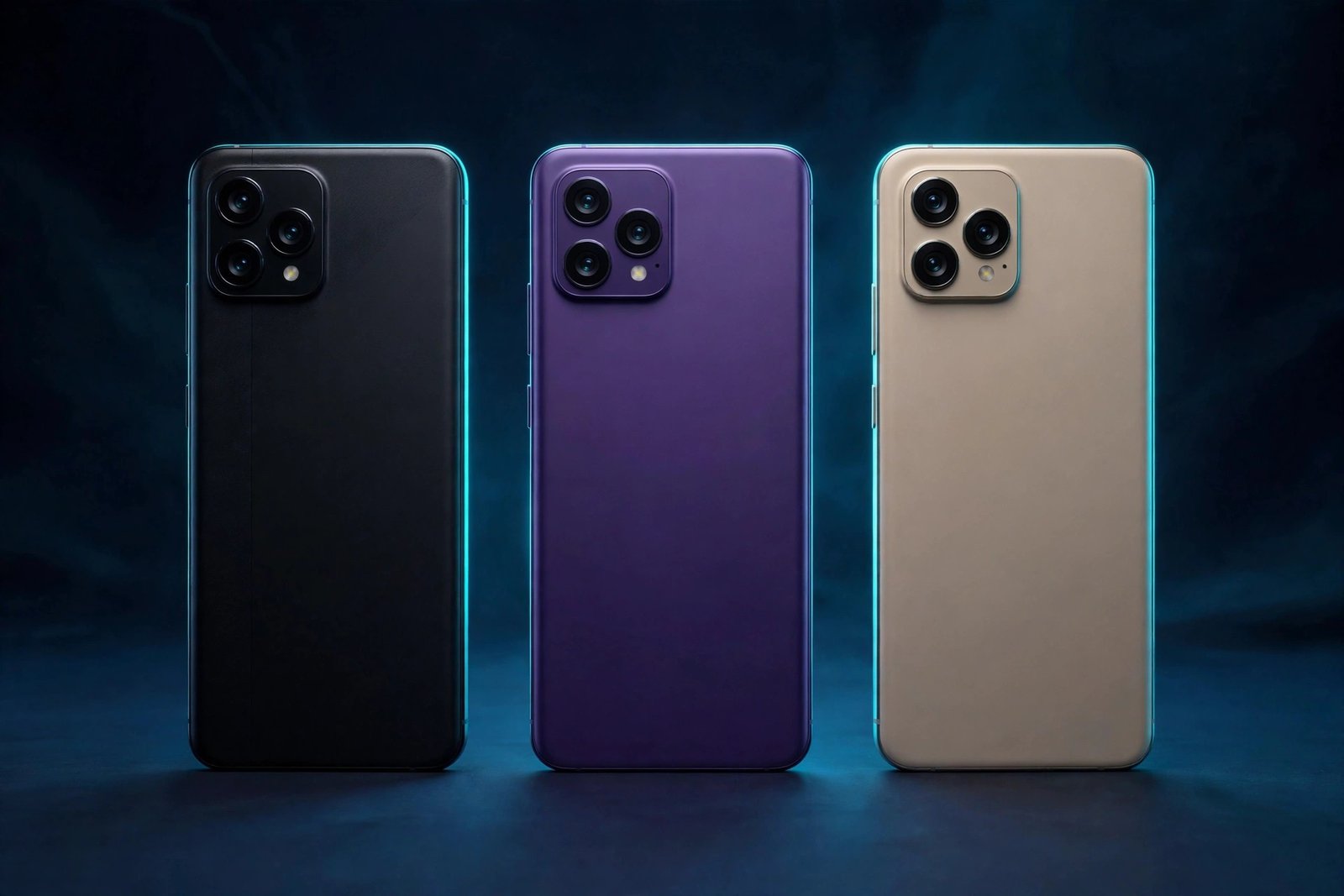
The design around the cameras has changed too. The square module gives the phone a cleaner, more angular look, and the frame is aluminium with a glass backplate. The phone measures 161.42 x 76.67 x 8.1–8.2mm and weighs 211 or 215 grams depending on the model. It comes in three colours globally: Infinite Black, Ultra Violet and Sand Storm — black, purple and beige, in plain language. There is no eco-leather option this time.
Price and Availability — and the US Wait
The global price starts at $899.99 for the 12GB RAM and 256GB storage model, and $999.99 for the 16GB and 512GB model. In Europe the same two models cost EUR 950 and EUR 1,050, with a limited-time discount on the larger model for early buyers. In India the phone launched at Rs. 85,999 for the base model, and it is already listed in stock at Amazon. In China, where it has been on sale since late October, the price starts at CNY 3,999, which is roughly $561 — much cheaper, as usual, than the global price.
At $899, the OnePlus 15 undercuts the most expensive flagships by hundreds of dollars while matching them on battery, display and chip. That has always been the OnePlus pitch, and it is sharper than ever here: the battery is bigger than anything in a mainstream flagship at this price, and the 165Hz display is unique.
The exception is the United States. The US launch has been delayed because of the government shutdown, with OnePlus saying it has completed its FCC testing and is waiting on certification. When sales do start, the phone will be available directly from OnePlus, from Amazon and from Best Buy, online and in stores, and it will work on all three major carriers — AT&T, T-Mobile and Verizon — as well as their MVNOs. None of the carriers sells it directly. For now, American buyers can only wait, and OnePlus has not given a firm date.
What It Means for Buyers
The OnePlus 15 is a phone with a clear priority: battery life and value. The 7,300mAh battery is the largest in its class, the charging is fast, the display is the smoothest you can buy, and the chip is the best Qualcomm makes. The price undercuts the competition by a wide margin, and the software support — four years of OS updates, six of security — is now competitive.
The open question is the camera. Smaller sensors than last year’s phone is an unusual move for a flagship, and it is the one area where the OnePlus 15 gives ground. If the image processing holds up, this is one of the best-value flagships of the year. If it does not, the phone is still an excellent choice for anyone who values battery and screen over photography.
For anyone coming from a OnePlus 13, the upgrade is real but not dramatic: a bigger battery, a faster screen, a newer chip, and a new design. For anyone coming from an older phone — or from a more expensive flagship — the OnePlus 15 is a strong case for spending less and getting more battery in return.
FAQs
Q: When did the OnePlus 15 launch globally?
A: The OnePlus 15 launched globally on 13 November 2026, seventeen days after its China debut on 27 October 2026. It went on sale the same week in Europe, India, Canada and other international markets.
Q: How much does the OnePlus 15 cost?
A: The OnePlus 15 starts at $899.99 for 12GB of RAM and 256GB of storage, and $999.99 for 16GB and 512GB. In Europe it costs EUR 950 and EUR 1,050, and in India it is listed at Rs. 85,999.
Q: How big is the OnePlus 15 battery?
A: The OnePlus 15 has a 7,300mAh silicon-carbon battery — the largest OnePlus has put in a flagship. It supports 120W wired charging (80W in the US and Canada) and 50W wireless charging.
Q: Why is the OnePlus 15 delayed in the US?
A: The US launch is delayed because of the government shutdown. OnePlus says it has completed FCC testing and is waiting on certification before sales can begin. No firm US sale date has been announced yet.
Q: What cameras does the OnePlus 15 have?
A: The OnePlus 15 has three 50-megapixel rear cameras: a main camera with Sony’s IMX906 sensor and optical image stabilisation, a 50MP ultrawide, and a 50MP periscope telephoto with 3.5x optical zoom. The front camera is 32MP.
Related Reading
- Xiaomi 18 Pro Global Launch Set for November 17 in Paris — Dual Rear Displays, Dual 200MP Leica Cameras
- OnePlus Ace 7 Pro Has a Built-In Cooling Fan — and It Just Sustained 185 FPS in a Gaming Test
- OnePlus 12 Gets Stable ColorOS 17 in India — Six Days Early
Sources: Android Headlines (13–14 November 2026); Smart Celler (13 November 2026); Gadgets 360 (14 November 2026); Android Authority (November 2026).
