


Carrying two phones is a pain. You pick up the spare, and the calls still go to the one sitting in your bag. Google may finally be fixing that. Code found inside a recent update to Google’s SIM Manager app points to a new feature called Android Fast Switch, which would let one phone number work on up to two Android phones — and move your mobile service to whichever phone you unlock.
The discovery comes from Android Authority, which spotted the new text strings in a teardown of the SIM Manager app and published its findings on November 16, 2026. 9to5Google and Digital Trends followed with their own coverage on November 17. Google itself has said nothing about the feature yet, and the code is a work in progress, so this is a leak of unfinished software rather than an announcement. But the strings are unusually specific, and they describe a feature Android owners have wanted for years.
Here is what the code actually says, what it would mean for anyone who carries two phones, and what is still unknown.
What Android Fast Switch Is
The clearest string in the teardown spells out the whole idea in one sentence:
“With Android Fast Switch, you can use your phone number on up to two phones. Mobile service automatically switches to whichever phone you unlock.”
Another string gives the feature a plain-English label: “Use a SIM on two phones.”
In practice, that would mean your single mobile number lives on both handsets at once. Unlock phone A and your calls and texts land there. Put it down, pick up phone B, unlock it, and the service follows you. There is no manual eSIM transfer, no swapping a physical SIM card, and no second line to pay for. The switch happens in the background, based on which phone you are actively using.
Android can already move an eSIM from one phone to another — Android 17 even rebuilt the Android Switch tool so it can move an eSIM from an iPhone — but today that is a deliberate, manual process. You start a transfer, wait for it, and the old phone loses service. Fast Switch would turn that one-off move into something automatic and constant.
Google’s Answer to iPhone Handoff
The obvious comparison is Apple’s iPhone Handoff, which arrived with iOS 27. Apple’s version lets iPhone owners share a single phone number across two phones, and Android Authority’s report frames Fast Switch as Google building its own version of the same idea.
The comparison matters because it tells us what kind of feature this is. This is not a new messaging app or a new kind of SIM. It is a convenience layer on top of the SIM you already have — a way to stop thinking about which phone holds your number and just use whichever one is in your hand.
It also tells us where the friction will probably come from. On the iPhone side, carriers have not treated Handoff as free. 9to5Google reports that T-Mobile charges $5 a month for the feature and Verizon charges $10, while AT&T does not support it at all. Google has not said anything about how carriers would treat Fast Switch on Android, and carrier support is one of the biggest open questions. A feature that depends on the network will only work if the networks agree to it — and if they do not charge extra for the privilege.
How It Would Work
The strings in the SIM Manager app give an early picture of the setup and the limits. Nothing here is final, and Google could change any of it before release, but the code sketches out a fairly clear flow.
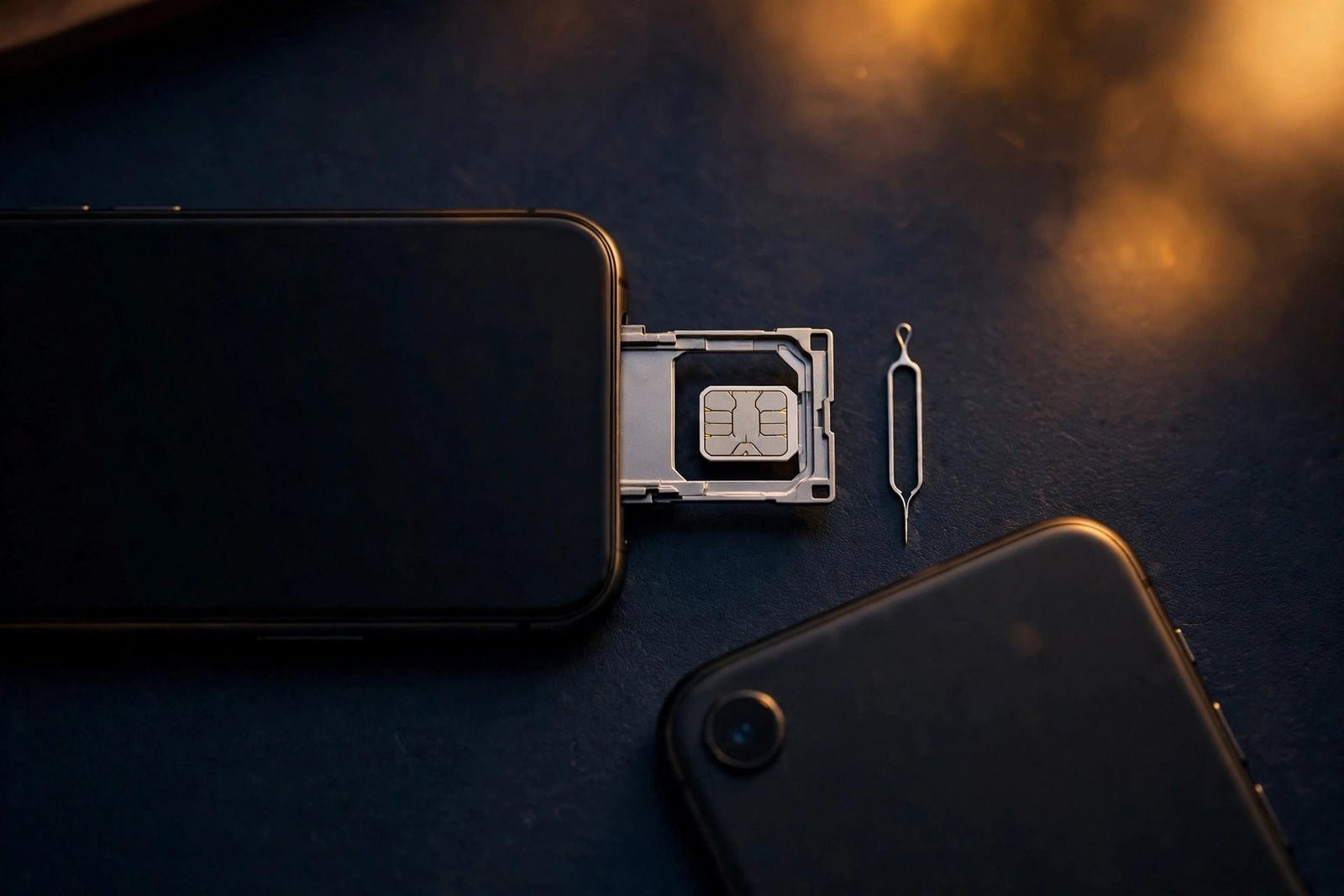
Two phones, one Google account
Both phones would need to be signed in to the same Google account. Fast Switch is explicitly designed for one person juggling two phones, not for sharing a line with someone else. The code includes consent strings for the sharing step, including messages for when the primary device’s owner declines or ignores the sharing request. In other words, you would set it up on your main phone, accept a sharing request, and the second phone would join as a companion device.
That same-account requirement is also a security boundary. It means nobody can quietly attach your number to their phone. The number only moves between devices that are already signed in as you.
Use the SIM once before sharing it
One string suggests you may need to use a SIM on a phone at least once before you can share it. That is a sensible anti-fraud step: the network sees the SIM active in a real device first, and only then does the sharing option unlock. It also hints that the feature works with ordinary SIMs, not only with eSIMs — though the exact mechanics are still unclear.
Not every SIM will work
Google is preparing a warning that some SIMs will not be compatible with the sharing arrangement. The teardown does not say which ones, or why. Carrier restrictions, older SIM profiles, and business or enterprise lines are all plausible reasons, but that is speculation. Until Google publishes details, the only safe reading is that compatibility will not be universal.
Which phones get it?
Android Authority says it has seen some evidence pointing to Pixel support, but it is not clear whether every Pixel would get it. That is worth underlining: this could easily end up as a Pixel-only feature, at least at first. Google has a habit of debuting this kind of system-level trick on Pixel phones before — or instead of — rolling it out to the wider Android ecosystem. Samsung, Motorola, and other makers would each need to support it in their own software, and there is no sign yet that any of them are involved.
Why This Matters
Two-phone life is more common than it sounds. People carry a work phone and a personal phone. Reviewers and developers carry a daily driver and a test device. Travellers carry a local phone and their home phone. In every case, the same annoyance shows up: the phone in your hand is not always the phone your number lives on.
Today, the workarounds are clumsy. You can forward calls, but forwarding is fiddly and it does not cover texts cleanly. You can move an eSIM, but that is a deliberate transfer, not something you do ten times a day. You can pay for a second line, but that is exactly the cost Fast Switch would remove.
Fast Switch attacks the problem at the right layer. Instead of asking you to manage the number, it asks the phones to manage it for you. Unlock the phone you are holding, and that is the phone that rings. It is a small idea, but it is the kind of small idea that makes carrying two phones feel normal instead of annoying.
It also fits a pattern in Android 17. Google has spent this release cycle smoothing out the edges of multi-device life: the rebuilt Android Switch tool for moving eSIMs, tighter links between phones, watches, and tablets, and now — if the code ships — a way to stop worrying about which phone holds your number. Fast Switch would be the most practical of the three, because it solves a problem people hit every day rather than once when they buy a new phone.
What We Still Do Not Know
For all the detail in the strings, this is still an early teardown of unfinished code, and the unknowns outnumber the knowns.
There is no release date. The strings are in a SIM Manager app update, not in a public Android release. Android Authority’s own note on the report is the standard one for this kind of find: the feature is a work in progress and may never ship. Google has not announced Fast Switch, put it on a roadmap, or shown it working. It could arrive in weeks, in months, or not at all.
There are no screenshots. Nobody has seen the setup screen, the toggle, or the sharing prompt. Everything we know comes from text strings, which describe what a feature does but not how it feels to use.
Carrier support is a blank. The iPhone version of this idea runs into carrier fees and carrier refusals. Whether Fast Switch needs carrier support at all — and whether carriers will charge for it — is unknown. If carriers treat it like a second line, the feature loses much of its appeal.
The device list is unknown. Pixel support looks likely, based on the evidence Android Authority found, but nothing says which Pixels, or whether Samsung, Motorola, or other Android makers will ever get it. A Pixel-only launch would leave most Android owners waiting.
The details of the switch are unclear. The strings say service “automatically switches to whichever phone you unlock,” but they do not say what happens to an active call when you unlock the other phone, whether texts sync between the two devices, or how quickly the switch happens. Those are the details that decide whether the feature is genuinely useful or just a neat demo.
What to Do If You Carry Two Phones
Nothing changes today. Fast Switch is not available, not in beta, and not something you can turn on. But if you do carry two phones, the story is worth watching for two reasons.
First, the code is already in a shipping app. Strings like these usually appear when a feature is being prepared for a real rollout, even if that rollout is months away. It is a stronger signal than a patent filing or a rumour.
Second, the iPhone precedent shows the shape of the catch. When Fast Switch does arrive — if it arrives — the first question to ask is not whether it works, but what your carrier charges for it. A feature that costs $5 or $10 a month is a different proposition from a free one, and the carriers have already shown with iPhone Handoff that they see this as a billable extra.
For now, the practical advice is the same as ever: keep your eSIM transfer in mind when you switch phones, and do not pay for a second line just to solve the two-phone problem. If Fast Switch ships, the second line may become unnecessary.
The Bottom Line
Android Fast Switch is Google’s answer to iPhone Handoff: one phone number, two Android phones, with mobile service following whichever phone you unlock. The evidence comes from strings in a recent SIM Manager app update, found by Android Authority and corroborated by 9to5Google and Digital Trends. Both phones would need the same Google account, you would accept a sharing request, and some SIMs may not be compatible.
But it is still unfinished code with no announcement, no date, and no screenshots. It may be a Pixel-only feature, it may need carrier support, and it may never ship at all. The idea is exactly right. Whether Google finishes it is the part we are still waiting on.
Related reading
- Pixel Camera Not Working After November Update? Fix It
- Pixel Search Expands to Pixel 6 and Newer in November 2026
- Motorola Android 17 Beta Opens for 14 More Phones
Frequently Asked Questions
What is Android Fast Switch?
Android Fast Switch is an unreleased Google feature found in the code of a recent SIM Manager app update. It would let you use one phone number on up to two Android phones, with mobile service automatically switching to whichever phone you unlock.
When will Android Fast Switch be released?
There is no release date. Google has not announced the feature, and the code Android Authority found is a work in progress. It could arrive in weeks or months, or it may never ship at all.
Will Android Fast Switch work on all Android phones?
Probably not at first. The teardown found evidence pointing to Pixel support, but it is unclear whether every Pixel would get it, and there is no sign yet that Samsung, Motorola, or other makers are involved. It could easily launch as a Pixel-only feature.
Do both phones need the same Google account for Fast Switch?
Yes, according to the strings found in the SIM Manager app. Both phones must be signed in to the same Google account, and you must accept a sharing request on the primary phone. The feature is designed for one person with two phones, not for sharing a line with someone else.
Will carriers charge extra for Android Fast Switch?
Unknown. On the iPhone, carriers charge for the equivalent feature — 9to5Google reports $5 a month at T-Mobile and $10 at Verizon, while AT&T does not support it. Google has said nothing about carrier pricing or support for Fast Switch on Android.
Sources: Android Authority (November 16, 2026); 9to5Google (November 17, 2026); Digital Trends (November 17, 2026).
