


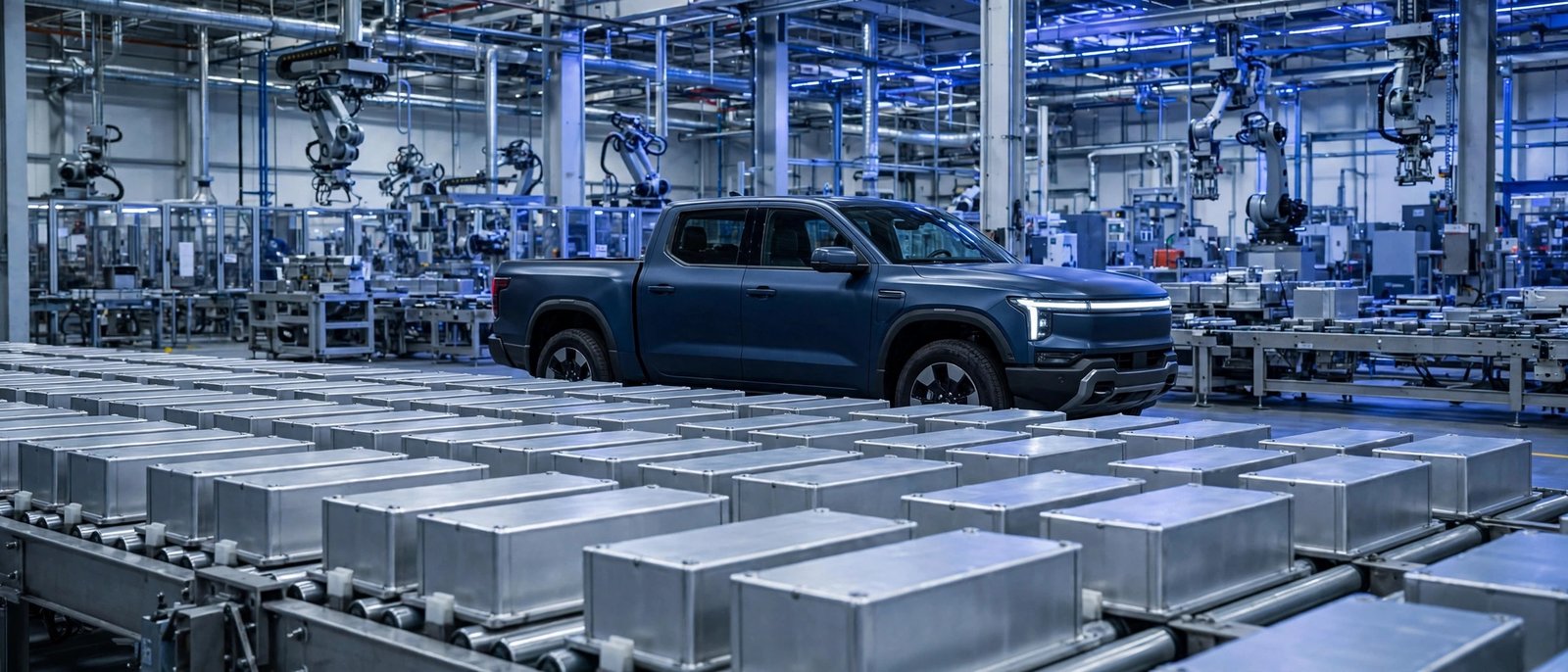
Ford’s affordable electric truck just moved from a promise to a production line. The company has shipped the first lithium iron phosphate (LFP) battery cells from its new BlueOval Battery Park Michigan plant, and they are on their way to the Louisville Assembly Plant in Kentucky, where they will power the first pre-production prototypes of the Ford Fathom — the midsize electric pickup Ford plans to sell from $28,350.
It is the kind of milestone that sounds small and means a lot. Until now, the Fathom has been a price, a platform and a set of renderings. Now Ford is making its batteries in a plant it owns and operates, at a pace it says is among the fastest LFP lines outside China. For a truck whose entire pitch is “an electric pickup ordinary buyers can actually afford,” the battery is the whole story — batteries make up roughly 40% of an electric vehicle’s cost, and this is where Ford plans to win that argument.
Here is what happened, why the battery chemistry matters, when you can actually order one, and what Ford still has not told us.
What Happened: The First Cells Leave Michigan
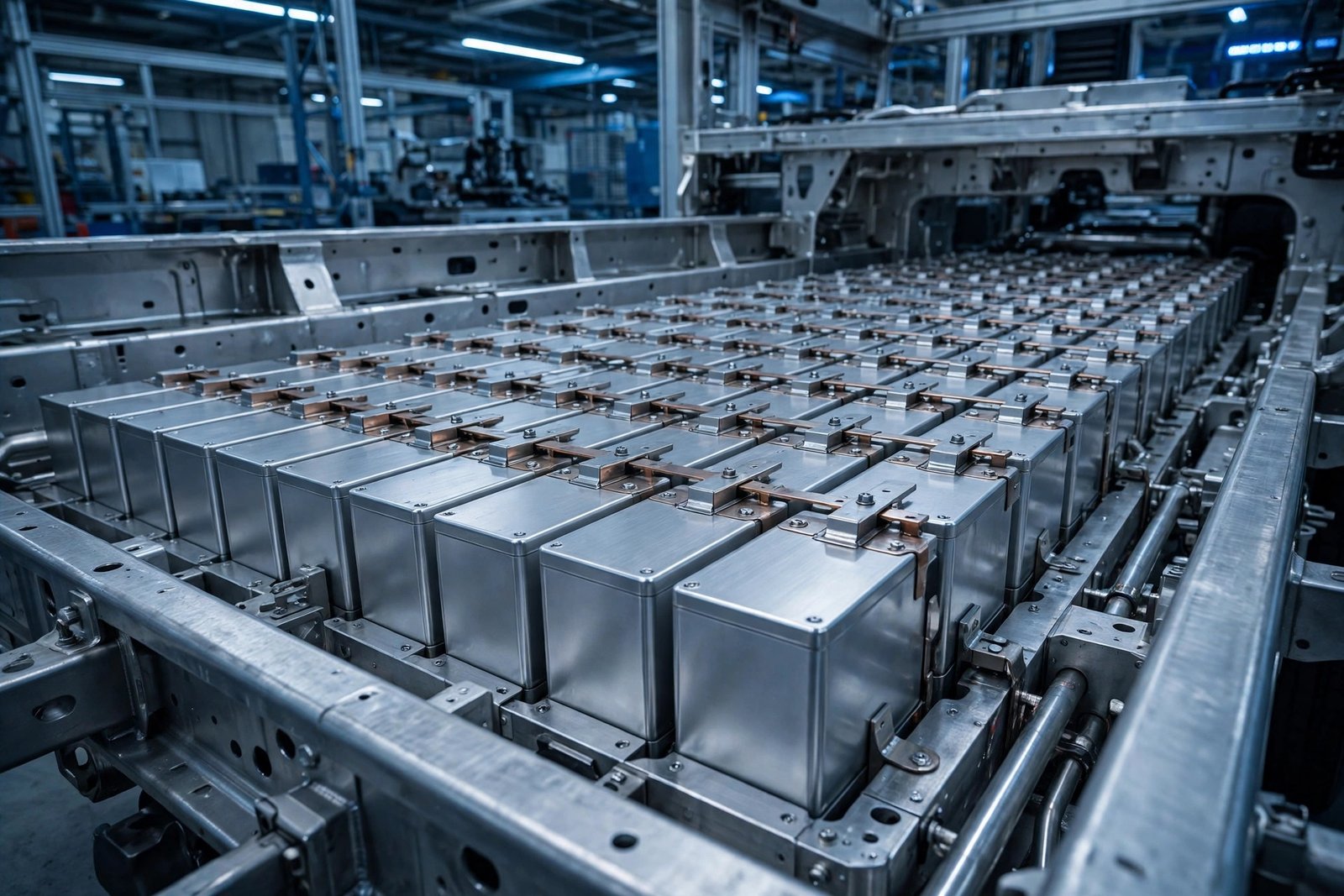
Ford confirmed on November 18, 2026, that the first production-grade LFP prismatic battery cells have rolled off the line at BlueOval Battery Park Michigan in Marshall, about two hours west of Detroit. The cells are headed to Louisville, where they will be installed in Fathom prototypes as Ford puts the finishing touches on the truck ahead of production.
This is not a pilot line or a symbolic first batch. The $3 billion, 2-million-square-foot facility launched production on October 10, 2026, and Ford says its assembly lines can deliver 40 cells every minute, making it one of the fastest LFP prismatic battery assembly operations outside China. At full ramp-up the plant is expected to produce up to 20 gigawatt-hours of batteries a year, and InsideEVs reports it can build 50 battery packs an hour.
The scale of the operation is industrial in the old-fashioned sense: the building is about a mile long, with hundreds of robots and machines, and a single cell takes six and a half days to make, including a five-day aging process. Ford expects to have nearly 800 employees at the plant by the end of the year, out of 1,700 jobs it has committed to creating there.
Quality is the part Ford is most nervous about, and it shows. The cells are not serviceable once they are sealed into a battery pack, so the factory runs AI-powered image recognition and other inspection systems to catch defects. Ford has contracted engineers from CATL — the Chinese battery giant whose technology the plant licenses — to work on site through the ramp-up, with defect targets measured in parts per billion rather than the higher error rates typical in auto manufacturing.
Why LFP Matters: The Chemistry Behind the $28,350 Price
The Fathom’s headline price is only possible because of the battery inside it, and Ford chose LFP deliberately. Lithium iron phosphate batteries do not use nickel or cobalt, two expensive materials whose prices swing with global supply chains. Skipping them is the single biggest reason Ford can target a $28,350 starting price — $1,595 destination and delivery fee on top — for a midsize electric pickup.
LFP brings practical advantages for owners, not just accountants. The chemistry is known for durability over thousands of charging cycles, and unlike nickel-based batteries, LFP packs can be charged to 100% every day without the usual advice to stop at around 80%. Ford executives have also said the Fathom will be able to power a home during an outage or at peak-rate times, and that the battery should last a decade or more.
Ford’s engineers did not just pick a cheaper chemistry — they redesigned the pack around it. The prismatic cells are rectangular, so they fit directly into the chassis, and the pack itself is designed to act as the structural floor of the truck rather than a heavy box bolted onto a frame. Ford has also integrated the electrical connections, sensing systems and power electronics into the pack to cut parts, weight and manufacturing complexity. The point is the same throughout: make the battery pack as efficient as possible instead of simply making it bigger.
The Factory: Ford Is Now a Battery Maker, Not Just a Battery Buyer
The Marshall plant matters beyond the Fathom. Its launch marks Ford’s entry into battery manufacturing at a facility it owns and operates, and the company says the technology and processes developed there will support future vehicle programs and its Ford Energy stationary energy-storage business in Kentucky.
That vertical integration is also a cost play. By making its own cells, Ford avoids supplier mark-ups, keeps full control of the technology, and can take advantage of federal battery production tax credits tied to sourcing materials from allied nations. The plant is fully integrated: raw lithium and iron-phosphate powder go in one end, and fully assembled, ready-to-install battery packs come out the other, with anode and cathode production and every major process in between happening inside the same building.
The strategy is central to Ford’s wider EV turnaround. The Fathom is the first vehicle on Ford’s new Universal Electric Vehicle (UEV) platform, developed by the small team Ford originally set up separately from its main EV operation. Ford is counting on the UEV platform — and the cheap batteries that make it viable — to help turn around its money-losing Model e EV business by 2029.
The CATL Question: The One Controversy Ford Can’t Avoid
There is one awkward fact about Ford’s American battery plant: the technology is licensed from CATL, the world’s largest EV battery maker, based in China. Ford has been open about this — Vice President of Advanced Development Projects Alan Clarke told media this week that working with CATL was the fastest way to build affordable electric vehicles in the United States — but the arrangement has drawn scrutiny from US lawmakers and officials.
US Transportation Secretary Sean Duffy wrote to Ford CEO Jim Farley in September raising concerns about the company’s reliance on licensed CATL technology at the Marshall plant. Ford’s answer is that the plant itself is American-owned and American-operated, the cells are made in Michigan by American workers, and CATL’s role is technology licensing plus on-site engineering support while Ford’s own operators are trained up.
For buyers, the controversy is unlikely to change the truck. For Ford, it is a political risk it has decided is worth taking: without CATL’s proven LFP technology, the $28,350 price — the entire point of the Fathom — would be far harder to hit.
When Can You Buy One? The Timeline From Here
The battery shipment sets off a clear sequence of dates, and Ford has now confirmed most of them:
- Now: First LFP cells shipping from Marshall to Louisville for Fathom prototypes.
- First quarter of 2027: Production-qualified builds begin, using the packs assembled from these cells.
- Early 2027: Preorders open, with a starting MSRP of $28,350 plus a $1,595 destination and delivery fee.
- 2027: Ford’s battery pack assembly facility in Marshall becomes fully operational ahead of launch.
- Fourth quarter of 2027: Customer deliveries begin, if the production launch goes according to plan.
That is roughly a year between the first battery shipment and the first customer trucks. It sounds slow, but it is the normal shape of a vehicle launch: the prototypes now being built in Louisville will be used to refine the battery pack and the vehicle through every phase of development before full-scale manufacturing begins.
What Ford Still Hasn’t Told Us
For all the detail about the factory, Ford has not yet published the numbers buyers actually shop with. There are still no official figures for battery capacity, performance, towing or payload. The company has also not confirmed an official EPA range figure.
What we do know: Ford executives have expressed confidence the Fathom will offer the 300 miles of range many consumers look for. MotorTrend estimates the standard LFP pack at roughly 64–67 kilowatt-hours, with an optional larger nickel-based battery targeting more than 300 miles of range. Those are estimates, not Ford specifications, and the final numbers will only come when Ford publishes them closer to launch.
The honest way to read this milestone is that the truck is real and the factory works — but the spec sheet is still blank. Anyone deciding whether to wait for the Fathom should watch for the preorder opening in early 2027, when Ford will have to put real numbers next to that $28,350 price.
Why This Matters Beyond Ford
The Fathom is the most important test yet of whether an American automaker can build a genuinely affordable electric vehicle without losing money on every one it sells. Every other affordable EV promise in recent years has either arrived late, arrived expensive, or arrived as a stripped-down compliance car. Ford’s answer is to attack the battery — the most expensive part — with cheaper chemistry, domestic manufacturing and a pack designed as part of the truck’s structure.
If it works, the Fathom will not just be a cheap electric truck. It will be proof that the US can build LFP batteries at scale, at speed, and at a price that makes electric pickups accessible to buyers who were priced out of the first wave. The first cells leaving Michigan do not prove that yet. But for the first time, the $28,350 truck has batteries in it — and that is the hardest part done.
Frequently Asked Questions
How much will the Ford Fathom cost?
The Ford Fathom starts at $28,350, plus a $1,595 destination and delivery fee. Ford has not announced pricing for higher trims or the optional larger battery yet.
When can I preorder the Ford Fathom?
Preorders are expected to open in early 2027. Customer deliveries are planned to begin in the fourth quarter of 2027, if production goes according to plan.
What kind of battery does the Ford Fathom use?
The standard Fathom uses lithium iron phosphate (LFP) prismatic battery cells made at Ford’s BlueOval Battery Park Michigan plant. LFP batteries skip expensive nickel and cobalt, cost less to build, last longer over repeated charging, and can be charged to 100% daily. An optional larger nickel-based battery is expected to target more than 300 miles of range.
How far can the Ford Fathom go on a charge?
Ford has not published an official range figure yet. Ford executives have said they are confident the Fathom will offer the 300 miles of range many buyers look for, and MotorTrend estimates the standard LFP pack at roughly 64–67 kWh. Final range figures will come closer to launch.
Where are the Ford Fathom’s batteries made?
At BlueOval Battery Park Michigan in Marshall, Michigan — a $3 billion Ford-owned plant that launched production on October 10, 2026. It is the first US plant building LFP batteries for mainstream consumer vehicles, using technology licensed from CATL. The cells are shipped to the Louisville Assembly Plant in Kentucky, where they go into Fathom prototypes.
Related Reading
- Tesla Assisted Driving Renamed in Europe: What Changed and What’s Next
- BMW Neue Klasse iX3 and i3 Get China Launch Dates for November 2026
- Volkswagen ID. Era 5X Electric SUV Debuts in China With 800V Platform
Sources: Autoblog, Reuters, Ford, InsideEVs, Holland Sentinel.
