


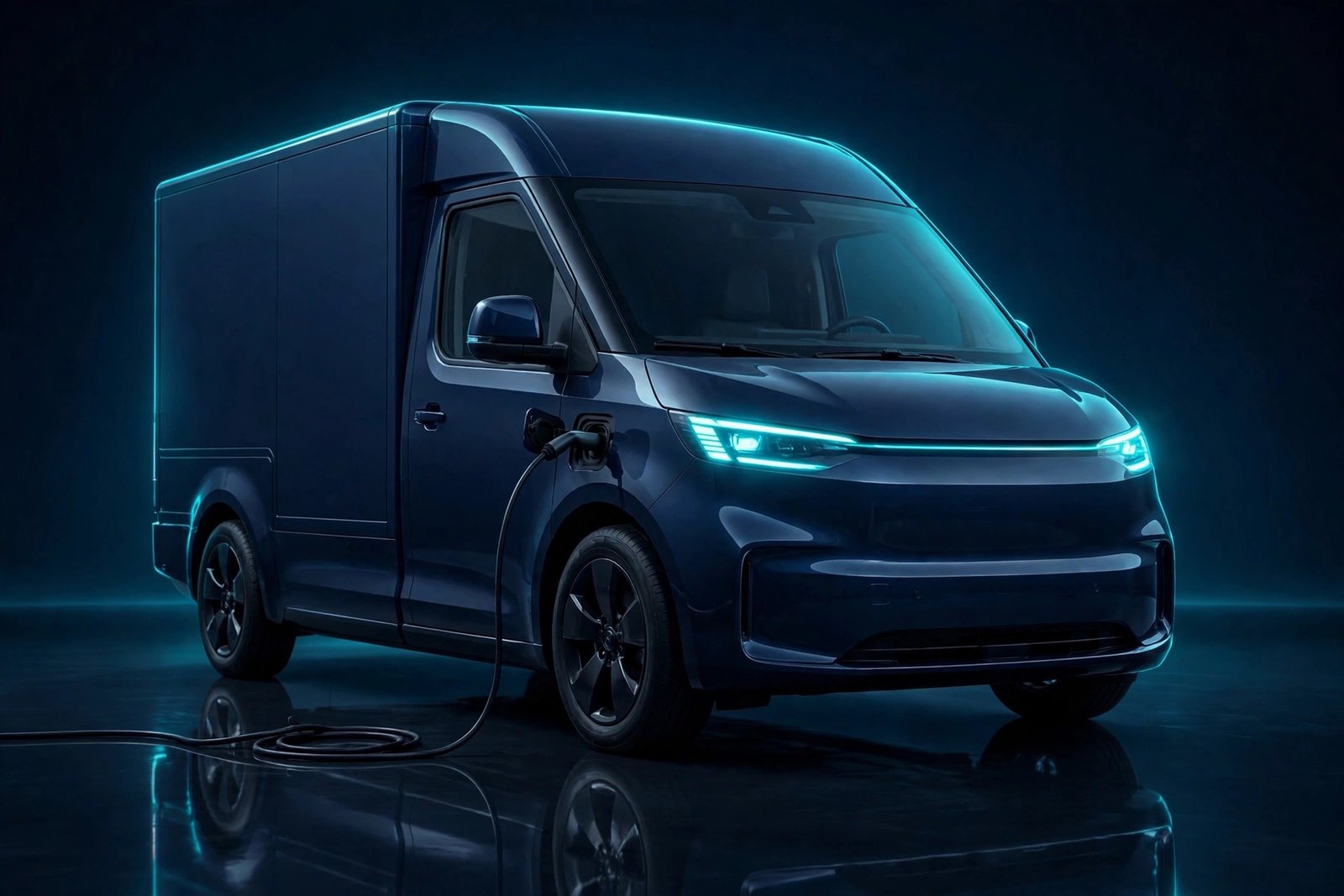
- Renault’s new Trafic E-Tech electric van is Europe’s first fully software-defined vehicle in the light commercial sector.
- It replaces up to 80 separate electronic control units with just two high-performance supercomputers running CAR OS, an Android-based operating system developed with Google.
- An 800-volt architecture delivers up to 240 kW DC fast charging, taking the larger battery from 15 to 80 percent in under 20 minutes.
- The long-range version travels up to 470 km on the WLTP cycle, and up to 690 km in stop-start city driving, according to Renault.
- UK pricing starts at £38,000 before VAT, with order books open since 5 November 2026 and first deliveries due in mid-2027.
- The van was crowned International Van of the Year 2027, but Renault has no plans to sell it in the United States.
Renault has taken the wraps off the most important van it has built in years, and the headline is not the battery or the range. The new Renault Trafic E-Tech electric is the first vehicle in Europe’s light commercial sector to be built from the ground up as a software-defined vehicle, a machine whose features are decided as much by code as by hardware. It was unveiled at the IAA Transportation show in Hanover in September 2026, where it was also named International Van of the Year 2027, and it went on sale in the UK on 5 November 2026.
That matters because vans have always been the most conservative corner of the car market. A delivery van is a tool, bought on payload, running costs and reliability, and its technology usually lags years behind passenger cars. Renault is betting that the next generation of fleet buyers will choose a van the way they choose a phone: on the strength of its software, its ability to gain new features after purchase, and how well it connects to the cloud services a business already uses.
The Trafic E-Tech is the first of five new light commercial vehicles Renault plans to launch by 2028 under its futuREady strategy, and it is the first model built on the company’s new RGEV medium-van platform. It is designed and built in Europe at Renault’s Sandouville plant in France, and it arrives as a panel van first, with chassis-cab and crew-cab versions following in 2027.
Two supercomputers replace 80 control units
The core of the Trafic E-Tech is its centralised electronic architecture. A conventional van scatters dozens of small computers, known as electronic control units, around the vehicle, each one responsible for a single job such as the brakes, the lights or the door locks. Renault says the new Trafic replaces as many as 80 of those units with just two high-performance supercomputers.
Those two computers run CAR OS, an Android-based operating system developed by Renault’s electric-vehicle division Ampere together with Google. The system is linked directly to Google Cloud, and the van functions as what Renault describes as an upgradeable rolling computer. Functions that used to be fixed at the factory can now be controlled, analysed and updated over the air, and the van can gain new features throughout its working life without a visit to a dealer.
For fleet operators, the practical payoff is the ability to plug their own software into the van. Renault says businesses will be able to integrate their own applications directly into the vehicle’s systems, for example for fleet management, route planning or monitoring refrigerated conversions. A separate business programme called Renault UPTIMIZE, scheduled to launch in 2027, is set to build on that capability with fleet-focused services.
The cabin reflects the same thinking. The main touchscreen runs an Android Automotive operating system with Google built in, including navigation that takes the vehicle’s height, load and road restrictions into account. It is the same openR link approach Renault uses in its passenger cars, adapted for a working vehicle.
800-volt charging and up to 470 km of range
Underneath the software, the Trafic E-Tech is built on an 800-volt electrical architecture, which makes it the only medium-sized electric van in the UK market with that technology at launch. Higher voltage means faster charging and less energy lost as heat, and Renault has paired it with a new 215 hp (160 kW) electric motor producing 345 Nm of torque.
Buyers get a choice of two batteries. The standard 60 kWh pack delivers up to 350 km on the WLTP combined cycle, or around 510 km in city driving. The larger 81 kWh pack extends that to up to 470 km on the WLTP cycle, or as much as 690 km in stop-start urban use, according to Renault’s figures. Both packs support DC fast charging at up to 240 kW, and Renault says the larger battery can go from 15 to 80 percent charge in under 20 minutes, adding up to 280 km of range in that time.
That charging speed is the van’s most useful number for a working day. A driver who plugs in during a lunch break can realistically recover most of a day’s driving, and the 800-volt system also supports vehicle-to-load capability, so compatible tools and equipment can be powered directly from the van’s battery on a job site.
Renault is still waiting for final WLTP homologation on the range figures, so the published numbers should be treated as the manufacturer’s targets rather than certified results. Independent real-world testing has not been reported yet, and city-range figures in particular tend to flatter electric vehicles because stop-start traffic maximises regenerative braking.

A working van first, a computer second
For all the software talk, the Trafic E-Tech still has to do a van’s job. It offers up to 5.8 cubic metres of cargo space and a payload of up to 1,300 kg, with towing of up to two tonnes once homologation is complete, according to early reports. Those figures put it squarely in the medium-van class, competing with established diesel and electric rivals such as the Ford E-Transit Custom.
The van is available in two wheelbases and in panel-van or crew-van forms, in Advance and Extra trim levels in the UK. Renault has not published a full equipment list for every market yet, but the standard kit includes the Google-based infotainment system, and the company is pitching the van’s ability to keep improving through software as a reason for fleets to buy now rather than wait for a later model year.
There is a catch for buyers outside Europe. Renault has no plans to sell the Trafic E-Tech in the United States, where the medium-van market is dominated by much larger vehicles and where Renault does not sell cars at all. The van is a European product, built in France for European fleets, and its software-defined architecture is aimed squarely at that market.
Price and availability
UK pricing for the Trafic E-Tech starts at £38,000 excluding VAT for the entry-level Advance L1H1 panel van with the 60 kWh battery, slightly undercutting the Ford E-Transit Custom. Government grant incentives may reduce the effective price further for eligible buyers. In mainland Europe, Renault lists the van from €41,500 for the 60 kWh version and from €47,000 for the 81 kWh long-range model.
Order books in the UK opened on 5 November 2026, and first deliveries are scheduled for mid-2027, with some reports pointing to the second quarter of the year. The panel van arrives first, with the chassis-cab and crew-cab derivatives joining the range later in 2027.
The Trafic E-Tech’s real test will come when it reaches fleets. Software-defined vehicles promise a lot, and Renault’s claim to be first in the European van market is a genuine milestone, but the value of over-the-air updates and custom apps will only become clear once operators have lived with the van for a year or two. What is already clear is that the humble delivery van has become a computer on wheels, and Renault got there first.
Why this van matters beyond the delivery world
The Trafic E-Tech is interesting well beyond the fleet market because it shows how quickly software-defined architecture is spreading from luxury passenger cars into work vehicles. The same idea is reshaping cars across the industry: manufacturers are replacing dozens of separate controllers with a handful of central computers, then selling features and improvements as software.
Kia’s 2027 lineup, for example, is built around the same shift, with its Pleos Connect infotainment system and Gleo AI assistant turning the car into a platform that can be updated and extended after sale. You can read our full breakdown of Kia’s 2027 software-first lineup, Pleos Connect and Gleo AI.
The 800-volt charging hardware is also part of a wider trend. Fast-charging times that were once the preserve of flagship electric cars are now reaching vans and more affordable models, and BYD’s Fang Cheng Bao Ti 9 recently demonstrated how quickly the technology is advancing with a nine-minute charging claim. Our report on the BYD Fang Cheng Bao Ti 9 and its nine-minute charging has the full details.
And the Android-based cabin is the same direction the rest of the industry is moving. Google’s software now runs in cars, on scooters and in vans, and the TVS iQube electric scooter recently gained Android Auto support, bringing car-style infotainment to two wheels. See our coverage of the TVS iQube getting Android Auto for how that works in practice.
Frequently Asked Questions
What is the Renault Trafic E-Tech?
The Renault Trafic E-Tech is a new all-electric medium van from Renault, unveiled at the IAA Transportation show in Hanover in September 2026. It is the company’s first software-defined vehicle and the first fully software-defined vehicle in Europe’s light commercial sector. It was named International Van of the Year 2027 and went on sale in the UK on 5 November 2026, with first deliveries due in mid-2027.
What makes the Trafic E-Tech a software-defined vehicle?
The Trafic E-Tech replaces up to 80 separate electronic control units with just two high-performance supercomputers running CAR OS, an Android-based operating system developed with Google. The van is linked to Google Cloud and can receive over-the-air updates, gain new features during its life, and let businesses integrate their own applications into its systems.
How far can the Renault Trafic E-Tech go on a charge?
The 60 kWh version travels up to 350 km on the WLTP cycle, while the 81 kWh long-range version reaches up to 470 km on WLTP, or up to 690 km in stop-start city driving, according to Renault. Final WLTP homologation is still pending, so these are manufacturer figures rather than certified results. Both batteries support 240 kW DC fast charging, with the larger pack going from 15 to 80 percent in under 20 minutes.
How much does the Renault Trafic E-Tech cost?
UK pricing starts at £38,000 excluding VAT for the entry-level Advance L1H1 panel van with the 60 kWh battery. In mainland Europe, Renault lists the van from €41,500 for the 60 kWh version and from €47,000 for the 81 kWh long-range model. Government grants may reduce the price further for eligible buyers in the UK.
When can you buy the Renault Trafic E-Tech, and is it coming to the US?
Order books opened in the UK on 5 November 2026, with first deliveries scheduled for mid-2027. The panel van arrives first, followed by chassis-cab and crew-cab versions in 2027. Renault has no plans to sell the Trafic E-Tech in the United States.
Sources: New Atlas, “800-V high-tech work van rewrites the rulebook for camping & commerce”, 15 November 2026; Auto Express, “New Renault Trafic E-Tech EV van goes on sale from £38,000”, 5 November 2026; FleetWorld, “New Renault Trafic E-Tech lands in UK from £38k + VAT with van grant eligibility”, 5 November 2026; AutoTrader, “Everything we know about the Renault Trafic E-Tech”, 5 November 2026.
