


Xiaomi has started rolling out HyperOS 4 to phones and tablets outside China, bringing Android 17, a new glass-style interface and a fresh round of AI features to more than 80 Xiaomi, Redmi and POCO devices. The company confirmed the global rollout on Wednesday, November 25, 2026, and published a full release schedule that runs in three waves from early November through December.
It is the biggest software update Xiaomi has shipped since it retired MIUI in 2023, and it arrives at a moment when the Android 17 rollout race is heating up. Google shipped Android 17 to Pixel phones in June, Samsung is pushing One UI 9 (Android 17) across its Galaxy range, and Xiaomi’s own 17 series were the first non-Pixel phones to get stable Android 17 over the summer. HyperOS 4 is the update that finally pairs that Android 17 base with Xiaomi’s own redesigned interface.
The rollout has already started — but most phones are still waiting
The global stable rollout began on November 3, 2026, according to Xiaomi’s published schedule, and it is deliberately staged. That means two owners of the same phone model can see the update days or even weeks apart, depending on region, carrier and server load. Xiaomi’s own fine print says the dates are estimates and can change based on region, carrier, model and development progress.
As of November 23, only five phones had a public, stable HyperOS 4 build available to everyone outside China: the POCO F8 Pro (global), POCO F8 Ultra (Europe), POCO X8 Pro (Europe), and the Xiaomi 17T Pro (global) and Xiaomi 17T (Europe), which moved from testing to public release on November 19. The new Xiaomi 18 Pro and 18 Pro Max, which launched globally on November 17, ship with HyperOS 4 already installed.
A much larger group of phones has what Xiaomi calls Pilot builds — stable-branch software released first to a limited group of owners who joined the Mi Pilot testing programme. That list includes the Xiaomi 17 and 17 Ultra, the Xiaomi 15 and 15 Ultra, the POCO X8 and X8 Power, the POCO X8 Pro Max, the Redmi Note 15 series, the Redmi 17, the Redmi 15C 5G and the Xiaomi Pad 8. Pilot builds usually reach everyone else one to two weeks later, so these phones should move to public release in the coming days.
The newest batch of builds, compiled on November 20 and announced on November 21, was Xiaomi’s biggest international HyperOS 4 batch so far, with first builds for the POCO X8, POCO X8 Power, Redmi 15C 5G, Redmi 17 and Xiaomi Pad 8, plus newer builds for the Redmi Note 15 series, Xiaomi 15 and POCO X8 Pro Max. A live firmware tracker that checks Xiaomi’s update servers several times a day recorded 25 new HyperOS 4 builds outside China this week, taking the total to 49 devices with HyperOS 4 — 38 of them on stable builds — and 24 devices outside China so far.
Which phones get HyperOS 4, and when
Xiaomi’s global schedule covers 82 devices across the Xiaomi, Redmi and POCO brands, split into three starting windows: early November, mid-November and December 2026.
The early-November wave covers the Xiaomi 17, 17 Ultra, 17T and 17T Pro, plus the Leica Leitzphone, the Redmi Note 15 series, Redmi 17, Redmi 17C and Redmi 15C models, the POCO F8 Ultra and F8 Pro, POCO X8 Pro and X8 Pro Max, POCO M8, M8 Pro and C95 Pro and C85, and the Xiaomi Pad 8 and Pad 8 Pro.
The mid-November wave adds the Xiaomi 15, 15 Ultra, 15T and 15T Pro, the full Redmi Note 17 series and the POCO F7 and F9 families. The December wave then brings in the older flagships: the Xiaomi 14 and 13 series, the 13T and 14T series, the MIX Flip, the Redmi Note 14 series and the POCO F6, X6 Pro and X7.
One wrinkle is worth knowing about. Xiaomi published the schedule twice, on November 3–4 — once as an image on its HyperOS account on X and once on its mi.com website — and the two versions disagree on seven phones: the Xiaomi 15 and 15 Ultra, the four Redmi Note 17 models and the POCO X8. The X post puts them in the early-November wave; mi.com puts them in mid-November. Everything checkable so far supports the mi.com version: none of the seven has a public HyperOS 4 build yet, and the Xiaomi 15 only received its China release on November 16. This article follows the mi.com schedule.
China, as usual, is well ahead. The China rollout started on October 15 and already covers the Xiaomi 17 series, the Redmi K90 and K100 series, the Redmi Turbo 5 series, the Xiaomi Pad 8 Pro and, since November 14–17, the Xiaomi 15 series, MIX Flip 2, Civi 5 Pro and Redmi K80 series. Global builds usually follow the China ones by a few weeks.
What is new in HyperOS 4
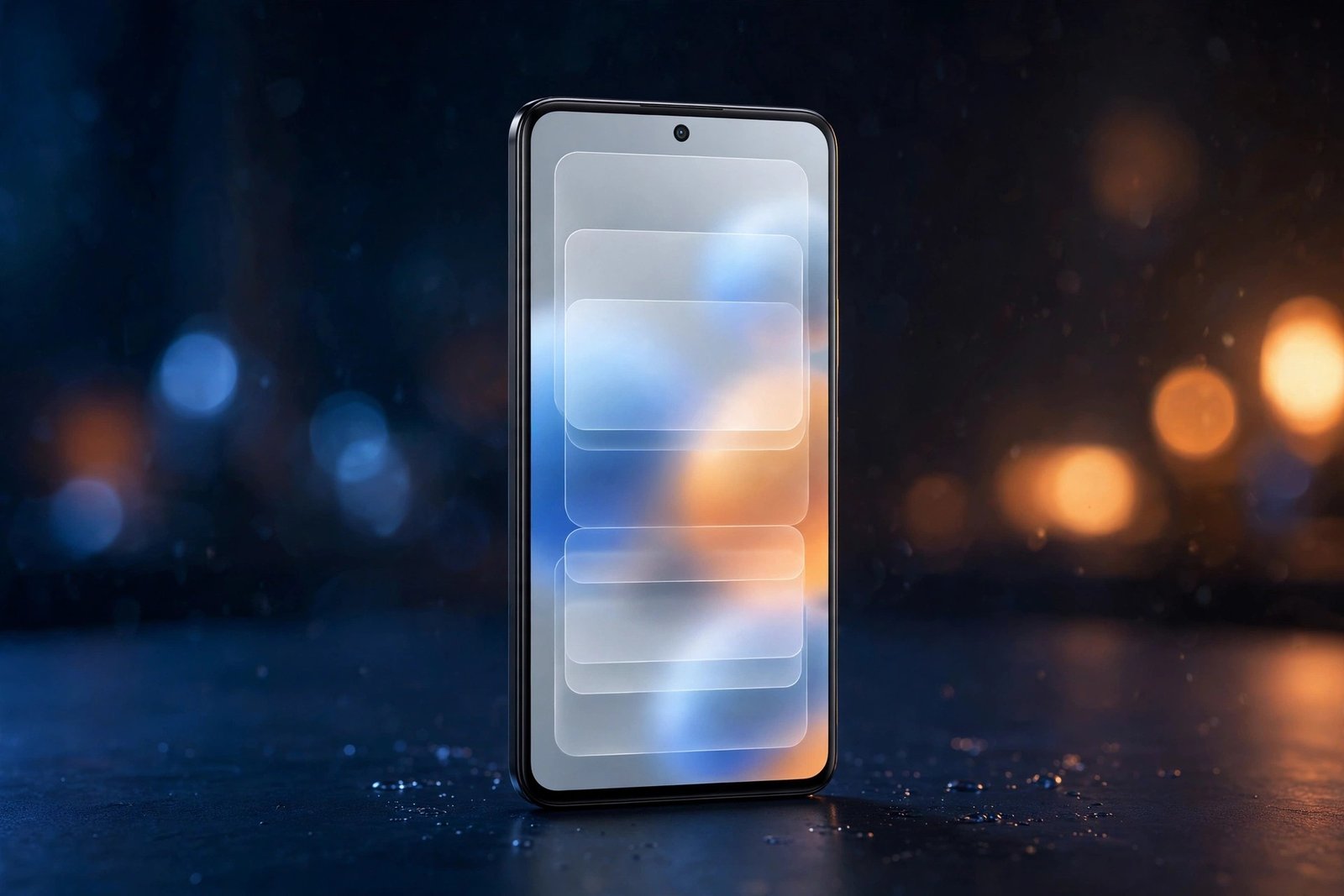
The most visible change is the new Life Aesthetics design language, built around what Xiaomi calls the Soft Light Glass effect. Instead of flat panels, system elements such as lock screen numbers, widgets, notification cards and Control Centre toggles behave like layers of frosted or polished glass, with translucent blur, layered cards and lighting effects that react to the wallpaper and what is on screen. It is the same liquid-glass direction Apple took with iOS 26, applied across the whole system rather than to a few elements.
The lock screen gets flexible clock styles that can be stretched, rescaled or repositioned, similar to the customisable clock on iPhones running iOS 26, and incoming notifications now stack vertically instead of appearing as individual cards that crowd out the wallpaper. Widgets can be stacked too — up to 10 widgets in a single home screen slot, swiped through with physics-based transitions — and app folders can be resized by dragging from a corner. The Control Centre gets rounded icons with transparent toggles, and the Fusion Device Center, Xiaomi’s hub for managing phones, tablets, watches, computers and smart home products, gets a clearer layout with pinned devices and one-tap switching between homes.
Under the surface, Xiaomi says it reworked a large part of HyperOS for this release. The system launcher and gallery apps were rebuilt from scratch, and the company claims the gallery now loads its thumbnail library 90 percent faster. A new HyperCore optimisation layer uses AI to preload frequently used assets, and Xiaomi says app launches feel snappier and long-term smoothness and battery life are improved. Those figures come from Xiaomi’s own laboratory tests, so real-world gains will vary by device.
The AI centrepiece is Super XiaoAi 2.0, a rebuilt assistant powered by Xiaomi’s in-house MiMo large language model, specifically MiMo V2.5. A new Inspiration Ball feature analyses what is on screen and suggests relevant actions such as map navigation, calendar entries or shopping links. The Notes and voice recorder apps gain AI transcription and summarisation. Xiaomi has not confirmed which of these AI features will reach global builds, since several were shown first in the Chinese version.
One of the more distinctive additions is Dual-Phone Syncing, which lets two Xiaomi, Redmi or POCO phones share incoming phone calls and SMS verification codes in real time — useful for anyone carrying a work phone and a personal phone.
Not every phone gets the full experience. The deeper glass effects are reserved for newer flagship chipsets — Xiaomi’s list includes the Snapdragon 8 Elite, Dimensity 9500 and Xring O1 or newer — so budget phones in the schedule will get a lighter version of the redesign.

How to check for the update
Owners of a phone in the early or mid-November waves can check manually in Settings, under About phone and then System update. Because the rollout is staged, the update may not appear immediately even for a listed phone, and there is no way to force it. Pilot builds are limited to Mi Pilot testers, and trying to install a Pilot package manually is usually refused with an “installation of this software version is prohibited” message unless the account is in the programme.
The downloads are large — full packages run from about 5.3 GB for the Redmi 17 to around 9.6 GB for the Xiaomi 15 Ultra — so it is worth updating over Wi-Fi with the battery charged, and backing up important data first, as with any major Android version upgrade.
What happens next
The December wave is the next milestone: the Xiaomi 13 and 14 families, the 13T and 14T series, the MIX Flip, the Redmi Note 14 series and the POCO F6, X6 Pro and X7. Release-candidate builds for several December-wave phones, including the Xiaomi 14T in Europe, have already appeared in Xiaomi’s internal test channels, which usually means a public release is days to a couple of weeks away.
For now, the practical picture is this: if you own a POCO F8 Pro, POCO F8 Ultra, POCO X8 Pro, Xiaomi 17T or 17T Pro, the update should already be available. If you own a Xiaomi 17, 17 Ultra, Xiaomi 15 or 15 Ultra, or one of the Redmi Note 15 or Note 17 phones, the build exists and is working its way from Pilot testers to the public channel. And if you own a Xiaomi 13 or 14 series phone, December is your month — with the usual warning that Xiaomi’s dates are estimates and can slip.
What the three waves mean for each brand
Xiaomi’s schedule treats its three brands as one programme, but the experience differs by price tier. The Xiaomi flagships lead: the 17 series and the 15 series sit in the first two waves, and the 18 Pro and 18 Pro Max skip the queue entirely by shipping with HyperOS 4. The Redmi Note series — Xiaomi’s volume sellers — are split across the first two waves, with the Note 15 family in the early wave and the Note 17 family in the mid-November wave, while the budget Redmi 15C and Redmi 17 models are in the early wave as well. POCO’s F8 and X8 flagships lead its side of the schedule, with the F7 and F9 families following in mid-November and the older F6 and X6 Pro and X7 waiting until December.
Tablets are not an afterthought this time. The Xiaomi Pad 8 and Pad 8 Pro are in the early-November wave, with the Pad 8 already having a Pilot build, and the Pad 7 series, Pad 7 Pro and the smaller Pad Mini have release-candidate builds compiled on November 18, which usually means a release within days. The Redmi Pad 2 Pro and its 5G version are also in the pipeline for the mid-November window.
The schedule also quietly confirms how long Xiaomi intends to support its older phones. The December wave includes phones launched in 2023, such as the Xiaomi 13 series, alongside 2024’s Xiaomi 14 series and the first-generation MIX Flip. For owners of those phones, HyperOS 4 will be the second major interface upgrade after HyperOS 3, and it arrives with the same Android 17 base as the newest flagships — the interface version and the Android version move together here, which was not always the case. Earlier this year, the Xiaomi 17 and 17 Ultra received stable Android 17 in July while staying on the HyperOS 3 interface; HyperOS 4 is the update that closes that gap.
The Pilot programme, and what not to do while waiting
The staged rollout has a testing layer that owners should understand before they go looking for the update. Xiaomi releases a stable-branch build to Mi Pilot testers first, then to everyone else, usually after one or two weeks. Owners report that Pilot builds only reach the testing group, and a manual install through the updater’s three-dot menu is often refused with an “installation of this software version is prohibited” message unless the account is in the programme. Approved testers can install the packages manually, but regular owners cannot — and should not try workarounds.
One warning is especially important for POCO owners. The China version of HyperOS 4 for the Redmi Turbo 4, the Chinese twin of the POCO X7 Pro, is already out — but installing the China firmware on the global POCO X7 Pro bricks the phone. The global build for the X7 Pro is a December-wave item, and owners should wait for it rather than sideloading the Chinese package. The same caution applies in general: a build compiled for the Chinese model of a phone is not interchangeable with the global model, even when the hardware looks identical.
Impatience is already visible in Xiaomi’s own community forums. Owners of the Xiaomi 17 were asking where the update was as early as November 11, a week after the rollout started. Xiaomi’s answer, in its schedule fine print, is that the listed dates are when the rollout starts, not when every phone in a wave receives it — region, carrier, model and development progress all affect the timing.
How HyperOS 4 fits into the Android 17 race
HyperOS 4 arrives in the middle of a busy Android 17 season. Google released Android 17 to Pixel devices on June 16, 2026, and shipped Android 17 QPR2 with the November Pixel Drop on November 10, bringing Gemini Intelligence features such as Rambler voice typing and AI-generated widgets to the Pixel 10 series. Samsung’s One UI 9, also based on Android 17, is rolling out across the Galaxy S25 and S24 series, with the One UI 9.5 beta already testing on the Galaxy S26 series ahead of a stable release expected in early 2027.
Xiaomi’s position in that race is notable: its 17 series were the first non-Pixel phones to get stable Android 17, and HyperOS 4 now gives those phones an interface to match. The company has also moved quickly on the underlying platform — Android 17 introduced app memory limits and performance features at the system level, and HyperOS 4’s HyperCore optimisation builds on those with AI-driven memory preloading. The result, on paper at least, is an update that is as much about speed as it is about looks: a rebuilt launcher and gallery, faster thumbnail loading, and smoother long-term performance are the claims Xiaomi is making alongside the glass redesign.
Whether those claims hold up in daily use will become clear as the rollout widens beyond the first five public devices and the Pilot group. For now, the rollout is moving at a steady pace — 25 new builds outside China in a single week, and the December wave already showing release candidates — which suggests Xiaomi intends to finish the programme on schedule rather than let it drift into 2027.
Frequently Asked Questions
When did the HyperOS 4 global rollout start?
The global stable rollout started on November 3, 2026, with the first public builds reaching the POCO F8 Pro, POCO F8 Ultra, POCO X8 Pro, Xiaomi 17T and Xiaomi 17T Pro. Xiaomi confirmed the rollout and published the full schedule on November 25, 2026. The rollout is staged, so not every listed phone gets it on the same day.
Which phones get HyperOS 4 first?
The early-November wave covers the Xiaomi 17, 17 Ultra, 17T and 17T Pro, the Redmi Note 15 series, Redmi 17 and Redmi 15C models, the POCO F8 and X8 families, the POCO M8 and C85/C95 Pro, and the Xiaomi Pad 8 series. The Xiaomi 18 Pro and 18 Pro Max ship with HyperOS 4 pre-installed.
Is HyperOS 4 based on Android 17?
Yes. HyperOS 4 is built on Android 17. Xiaomi’s 17 series phones were the first non-Pixel phones to receive stable Android 17 over the summer, but they kept the older HyperOS 3 interface until this update.
How do I check if my Xiaomi phone has HyperOS 4?
Go to Settings, then About phone, then System update. If the update is available for your model and region, it will appear there. If it is not showing yet, your phone is still in the staged rollout queue — Xiaomi releases it in waves by region, carrier and model.
What is new in HyperOS 4?
The headline changes are the Soft Light Glass redesign with translucent, layered interface elements, a customisable lock screen with stacked notifications, widget stacking, folder resizing, a rebuilt Fusion Device Center, the Super XiaoAi 2.0 assistant, Dual-Phone Syncing for calls and SMS codes, and performance improvements including a rebuilt launcher and gallery.
Will my Xiaomi 13 or 14 series phone get HyperOS 4?
Yes. The Xiaomi 13 and 14 families, the 13T and 14T series, the MIX Flip, the Redmi Note 14 series and the POCO F6, X6 Pro and X7 are scheduled for the December 2026 wave. Release-candidate builds for some of these models have already appeared in Xiaomi’s test channels, which usually signals a public release is near.
Sources: Gadgets360 (Nov 25, 2026), Xiaomi Firmware tracker (updated Nov 23–25, 2026), Android Authority, PhoneArena, Gizmochina.
